
Trump Signed the Meat Processing Executive Order. Here Is What It Actually Changes for Ranchers
A week ago we wrote that the promise to let ranchers process their own beef had no legal documents behind it. On Friday, September 4, it got some. President Trump signed an executive order titled Promoting Fair Competition in Livestock Markets and Expanding Market Access for American Meat Producers, with Agriculture Secretary Brooke Rollins and a group of ranchers beside him in the Oval Office, and told them: “For the first time ever, we're going to give farmers and ranchers the right to process their own food.”
That sentence and the order underneath it are two different things. We read the order, all four sections of it, so you do not have to. Here is what it actually orders, what it does not change, and what it means for a cow-calf operation in the Southeast.
What the meat processing executive order actually does
The order does four things, and every one of them is an instruction to USDA rather than a change in the law.
It turns up enforcement of the Packers and Stockyards Act. USDA is told to prioritize and expand investigations into packers for unfair, discriminatory or deceptive practices and for anything that restrains commerce or manipulates prices; to add staff and money to the Packers and Stockyards Division; to work cases jointly with the Justice Department under the antitrust agreement the two signed last September; and to hand the President a report within 60 days on current cases and a plan for the coming year. The four largest packers buy about 85 percent of fed steers and heifers, and this is the section aimed at them.
It pushes interstate sales through the state-inspection programs that already exist. USDA is told to speed up outreach so more states join the State Meat and Poultry Inspection program, the Cooperative Interstate Shipment program and the Talmadge-Aiken program; to build training and technical help for small and very small processors; to put up a web directory of local slaughter and processing capacity; to name a USDA coordinator who answers to ranchers and small plants; and to strip out inspection paperwork that does not serve food safety.
It creates a loan program for small plants. The Strengthening Processing for U.S. Ranchers guaranteed loan program is meant to keep small and regional beef processors open and help them expand. This is the same SPUR program USDA announced in June with up to $500 million behind it; the order tells the Secretary to stand it up.
It asks for a list of what is in the way. Within 60 days USDA must report which federal laws and trade rules keep state-inspected and custom-exempt meat from crossing state lines. That is the most interesting line in the document, because it is the first time an administration has ordered up the inventory that a change in the law would need.
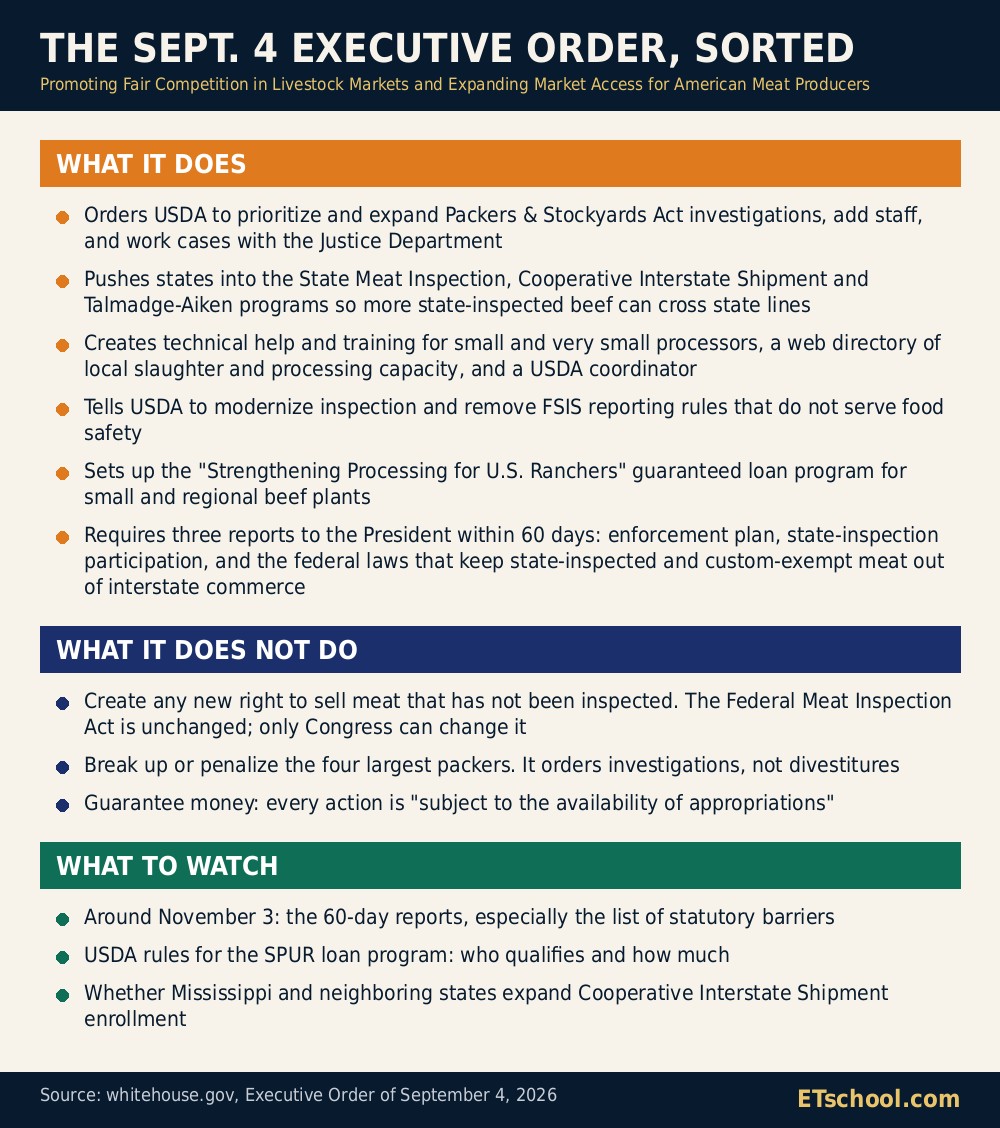 The September 4 order sorted into what it does, what it does not do, and what to watch for.
What it does not do
It does not let you sell meat that has not been inspected. The Federal Meat Inspection Act of 1906 is untouched. Meat sold to the public still has to come from a federally inspected plant, or a state-inspected plant under a program USDA has approved as equal to federal inspection. The order says so itself: every action is to be taken “consistent with applicable law.” Representative Thomas Massie, who has spent years pushing the PRIME Act to change that law, said it plainly the same afternoon: there is nothing new here that lets farmers process and sell their own meat. He is right about the law, even if the order does more than nothing.
It does not break up the big four. It orders investigations and reports. Cargill, Tyson, JBS and National Beef are not being split, fined or told to sell anything by this document. What happens to them depends on what the investigations find and what the Justice Department chooses to do about it.
It does not come with money attached. Section 4 says the whole order is “subject to the availability of appropriations.” The loan program, the staff, the training and the directory all depend on Congress funding them, and the Farm Bill is where that fight will be settled.
The President said at the signing that ranches that process their own beef will have inspectors, “just like these big plants.” That is a fair description of how a small inspected plant already works. It is not a description of something new.
Can a rancher sell his own beef? The three ways you can today
Yes, and you always could, through one of three doors. None of this changes the choices in front of you this fall.
- Custom exempt. A small custom plant slaughters and cuts an animal for its owner. The owner can be a customer who bought the live animal, or a share of it, from you. The meat is stamped Not For Sale and cannot be resold. This is the freezer-beef business most Southeast ranchers already know, and the order does not expand it.
- State inspected. About 27 states run their own inspection programs, Mississippi among them. A state-inspected plant can sell meat within the state. If the plant has 25 or fewer employees and the state has joined the Cooperative Interstate Shipment program, that meat can also cross state lines. This is the door the order is trying to push open wider.
- Federally inspected. A plant under USDA inspection can sell anywhere in the country. This is what the big four run, and what the growing number of small and mid-size regional plants run too. The loan program is aimed at those regional plants.
If you want to sell beef by the cut rather than by the animal, the practical question was, and still is, whether there is an inspected plant within driving distance that will take your cattle on a date you can plan around. USDA's directory, if it gets built, will at least tell you where to look.
What to watch, and when
The 60-day clock runs out around November 3. That is when the three reports are due, and the one to read is the list of statutory barriers, because it tells you what USDA thinks it can fix on its own and what it will ask Congress for. Watch also for the SPUR loan rules, which decide who qualifies, and for whether Mississippi and the states around it expand their Cooperative Interstate Shipment enrollment.
Why the herd is still the part that is yours
Every one of these policy moves, the tariff waiver two weeks ago, the Ranchers First package, this order, is about what happens after the calf leaves your place. The thing that decides your income is what happens before it does. The U.S. herd is the smallest in 75 years. A plant cannot raise a calf, and neither can a loan program. The producers who will do best out of a rebuild, whichever way Washington leans, are the ones who own the genetics they are selling and can breed to them without waiting on anyone.
That is a breeding decision, not a processing one. If you are keeping heifers this fall, breed them to the bulls you actually want rather than the one you happen to own, and calve them in a window tight enough to sell uniform groups. Learning to do that yourself takes a day and a half in our hands-on cattle artificial insemination training course, with no prior experience required. If you want to go further and multiply your best cows, the Combined AI & Embryo Transfer Training Course teaches artificial insemination first and then the complete bovine embryo transfer course, all in one trip to Senatobia, Mississippi, where we have been training ranchers and veterinarians for over 35 years. Most of the students in that room are cattle producers learning a skill for their own herds, and in some states, to offer as a service; the rules vary by state, so check yours.
 The next calf crop is decided out here, not in Washington.
We wrote about the Ranchers First package and the heifer-retention decision here: Ranchers First: what USDA announced and what it means if you are keeping heifers. For the import side of the same month, see what the 90-day tariff waiver means for cattle prices.
References
- Executive Order: Promoting Fair Competition in Livestock Markets and Expanding Market Access for American Meat Producers, The White House, September 4, 2026
- Fact Sheet on the order, The White House, September 4, 2026
- Trump signs orders to expand meat processing, protect herds from wolves, Reuters via U.S. News, September 4, 2026
- What Trump's executive order does, NewsNation, September 4, 2026
- Trump signs executive orders attempting to rebuild trust with cattle producers, Drovers, September 5, 2026
- Trump executive order aims to ease meat processing rules for ranchers, KTIV, September 4, 2026

|