
More Imported Beef, Lower Cattle Prices: What the 90-Day Tariff Waiver Means for Producers
On Friday morning, August 21, the President posted that he had concluded a deal to lower the price of ground beef, and that for the next 90 days the United States would allow up to 300,000 metric tons of product for ground beef to be imported with no out-of-quota tariff. He said there was a commitment that the beef would be sold 25 percent below current market prices.
Live and feeder cattle futures gapped lower on the open. They reached eight- to nine-month lows before recovering part of the loss, and still finished the week sharply down.
If you sell calves, that Friday cost you money. It is worth understanding exactly what was announced, what it is likely to do, and - more importantly - what it means for the decisions you make this fall.
What was actually announced
A few details matter here, because the shorthand version circulating is not quite right.
It is not yet a signed executive order. As of this writing, what exists is the announcement. A White House official said the President would formally sign an executive order implementing the arrangement within two weeks. Watch for the signed text, because the details that were left out of the announcement are the ones that determine the actual effect.
It is lean beef trimmings, not beef generally. This is targeted at the raw material that goes into ground beef, not at steaks or middle meats. That matters for where the pressure lands, and we will come back to it.
The mechanism is the out-of-quota tariff. The United States runs a tariff-rate quota system. Beef entering under a country's quota faces a token duty - the American Farm Bureau Federation put it at 4.4 cents per kilogram - while beef above the quota faces 26.4 percent. On beef worth roughly $7 per kilogram, Farm Bureau calculated the difference can exceed $1.80 per kilogram. Waiving the out-of-quota rate removes the wall that keeps additional volume out.
Nobody has said who is supplying it. The announcement did not name the exporting countries, did not say which quotas receive relief, and did not explain how a 25 percent retail discount would be verified or enforced at the meat case.
It is the second such move this year. In February, the administration signed a proclamation adding 80,000 metric tons per year of Argentine lean beef trimmings in quarterly tranches. That volume amounted to less than 5 percent of total U.S. beef imports in 2025. This one is much larger - roughly 15 percent of what the country imported last year.
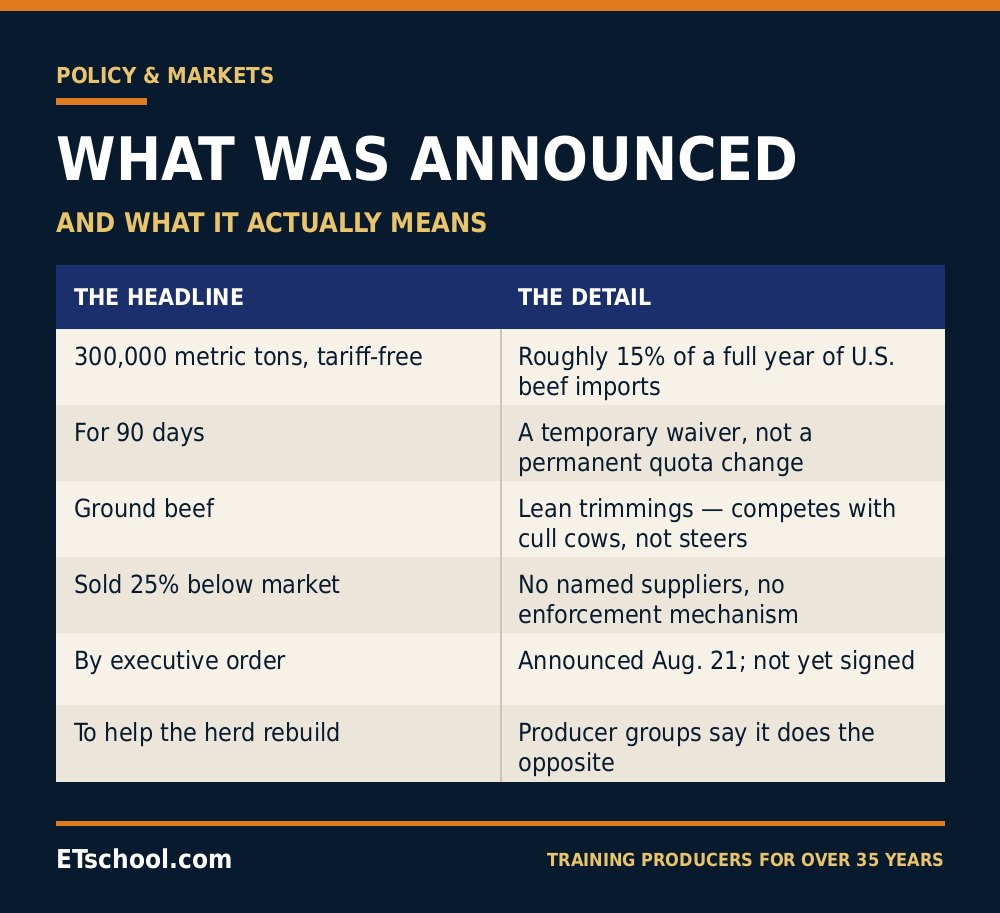 What was announced, and what it actually means.
Why it hits the cull cow market first
Here is the part most coverage skips, and it is the part that matters most to a cow-calf operation.
Almost all imported beef is lean processing beef. It comes into this country to be blended with fatter domestic trimmings to make ground beef at the lean points consumers buy. That means the direct competition is not with your fed steer. It is with nonfed beef - the beef that comes from cull cows and bulls.
Oklahoma State University economist Derrell Peel has laid out why imports climbed in the first place. Nonfed beef production fell 8 percent in 2025 and is down roughly 25 percent from 2022, the smallest total since 2005. Beef imports rose 18 percent in 2025 and are up more than 60 percent since 2022. The imports were the market's answer to a genuine shortage of lean grinding beef, not an arbitrary policy choice.
So when you hear "imported beef," think about the check you write off against your cull cows every fall - which, in a high-priced market, has become a meaningful share of a cow-calf operation's annual revenue.
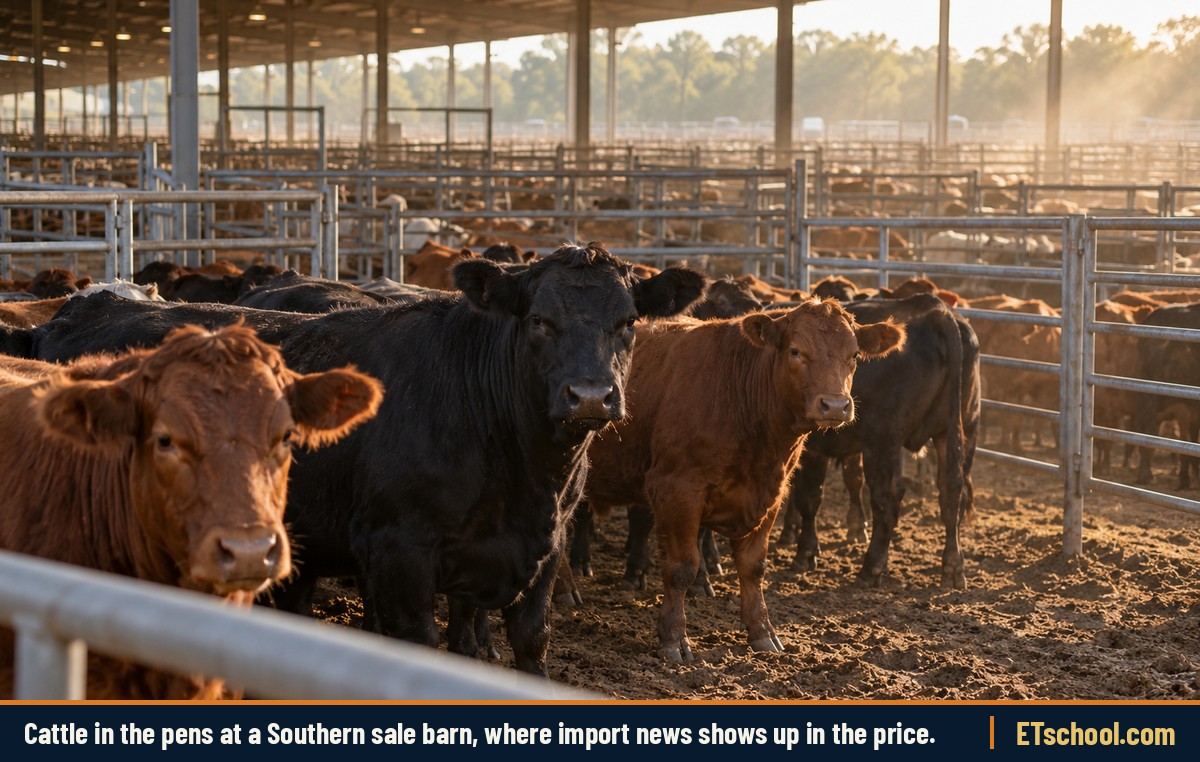 Cattle in the pens at a Southern sale barn, where import news shows up in the price.
Will it actually lower the price of hamburger?
Economists broadly say the effect on retail prices is likely to be small.
The reason is arithmetic. Ground beef has been running just under $7 a pound at retail, a record, and the cause is a cattle herd at 86.2 million head as of January - the smallest in about seventy years, with the beef cow herd down more than 8 percent since 2020. Three months of additional trimmings does not change that. The U.S. Cattlemen's Association made the point directly, arguing there is no clear evidence that adding imports this way lowers retail prices, while there is evidence that added volume depresses the prices paid to producers.
That is the asymmetry worth sitting with. The benefit to the consumer is uncertain and would be temporary. The cost to the producer showed up in the futures market within minutes.
Retail beef prices are also famously sticky on the way down. Packers and retailers set those prices, and there is no mechanism in the announcement that obligates anyone to pass a tariff saving to the person at the register.
The signal problem
The tonnage itself may not be the biggest issue. The signal might be.
Every producer group that responded said some version of the same thing. The National Cattlemen's Beef Association called the announcement disappointing and said "flooding the market with government-subsidized, below-market beef" is not how the American herd gets rebuilt. Farm Bureau, the U.S. Cattlemen's Association and state organizations raised the same objection, and Republican senators from cattle states publicly broke with the administration on it.
Their argument is about timing. Late summer and fall is exactly when producers decide whether to keep heifers. Keeping a heifer means giving up her sale value now and waiting more than two years for her to produce a calf you can market. Nobody makes that bet unless they believe the price will still be there.
And the rebuild had only just started. Heifer retention is up around 2.7 percent - the first real signal in nearly a decade - but heifers still made up 37.4 percent of cattle on feed on July 1, above the 32 to 34 percent share that historically marks the beginning of genuine expansion. That is stabilization, not expansion. It is a fragile thing to put a policy ceiling over.
The case on the other side
It should be said plainly that the administration's stated position is not unreasonable on its face.
Ground beef at a record price is a real burden on households, and it is the protein working families buy most. The administration argues the waiver is a short-term bridge - relief at the grocery store while the domestic herd is given time to grow - and points out that the herd contraction and the price run began well before this year. USDA has framed it as an affordability measure.
The disagreement is not really about whether beef is expensive. It is about whether importing lean trimmings for 90 days lowers what a family pays, and whether the market disruption is worth an effect most economists expect to be modest.
What a producer should actually do about it
Nothing in that Friday selloff changes the underlying supply picture, and it is worth keeping that in front of you.
The same morning the announcement landed, USDA's Cattle on Feed report showed July placements at 1.42 million head, down 11 percent and the lowest July figure since the series began in 1996. Marketings were also a record low for the month. Calf supplies for late 2026 and 2027 are tighter, not looser. A 90-day trimmings waiver does not create cattle.
Which points to the same conclusion a good market and a bad one both point to:
- Do not make a permanent decision on a temporary policy. Selling a productive cow because of a three-month import waiver is a five-year decision made on a ninety-day headline.
- Know your cost of production. Producers who know their numbers can tell the difference between a market that has turned and a market that got scared. Most of the people who lose money in volatile markets lose it by reacting.
- Consider whether risk management belongs in your operation. LRP coverage and futures or options exist precisely for weeks like this one. Talk to someone qualified about whether they fit your operation.
- Keep improving the herd. Policy moves the price you get this year. Genetics move what you have to sell every year after that.
That last one is not a slogan. In a market where the entire national conversation is about supply, the producers who come out ahead are the ones whose cows breed back on time, calve in a tight window, and wean a heavier, more uniform set of calves. That is a reproductive management question, and it is entirely within your control - which is more than can be said for trade policy.
Where we come in
You don't need to be a veterinarian to take our courses. The International Embryo Technology School has been training producers, herdsmen, technicians and veterinarians in bovine reproduction for over 35 years, and our courses are open to anyone 18 or older.
- Bovine Artificial Insemination - no prerequisites, no prior experience required. The starting point for controlling your own breeding and calving season.
- Comprehensive Bovine Embryo Transfer - 4.5 days of hands-on training for students already competent at AI. Veterinarians and veterinary technicians can earn RACE-approved continuing education credit on this course.
- Combined AI and Embryo Transfer - both, in sequence, for students starting from scratch.
You will learn a skill you can use on your own herd and, in some states, offer as a service. The rules on that vary by state, so check yours.
Markets and policy will do what they do. The quality of your cow herd is the part you own.
References
- Trump to allow import of 300,000 metric tons of ground beef without tariff, CNBC
- Trump Proposes Lifting Tariff Rate Quota on 300,000 Metric Tons of Beef Imports, DTN/Progressive Farmer
- Cattle groups react to Trump's beef import post, BEEF Magazine
- Trump Announces Deal to Slash Ground Beef Prices by 25%, Sends Markets Lower, Drovers
- Bullish Cattle on Feed Report Clashes With Plant Closures, Policy Fears, Drovers
- Cattle & Beef Market Outlook, USDA Economic Research Service

|