Bovine Ovum Pick-up (OPU) Training Course for Cattle IVF Programs
Course Info

Our 2.5-day (20 hour) Ovum Pick-Up (OPU) Training Course teaches OPU in cattle — ultrasound-guided oocyte aspiration for bovine IVF programs — in an advanced, hands-on format designed for experienced beef and dairy producers and veterinarians seeking to add oocyte aspiration and laboratory techniques to their reproductive toolbox. This course combines focused classroom instruction with extensive hands-on training using industry-standard ultrasound, aspiration, and laboratory equipment, emphasizing the technical skills, decision-making, and workflow required for successful OPU in commercial cattle operations and veterinary practice.
The course begins with targeted classroom instruction covering OPU principles, equipment setup, ultrasound-guided ovary mapping, and oocyte handling workflows. Participants then move quickly into hands-on training, with the majority of the course dedicated to live-animal and laboratory work. Because OPU is a highly technical and invasive procedure, strong palpation skills are essential. This course is best suited for students who are already confident in reproductive anatomy, rectal palpation, and ovary manipulation. In many states, OPU must be performed by a licensed Doctor of Veterinary Medicine (DVM) or under veterinary supervision; participants are responsible for understanding and complying with applicable state regulations.
By the end of the course, participants will have hands-on experience in ultrasound-guided ovary mapping, oocyte aspiration, oocyte identification and handling, and preparation of oocytes for shipment to an IVF laboratory. Students will also gain a clear understanding of how OPU integrates into advanced reproductive programs, including donor management, scheduling, and coordination with IVF laboratories. Class size is intentionally limited to maximize hands-on time, individualized instruction, and direct feedback from instructors.
Oocyte processing is the most important aspect of OPU and IVF success. Students will learn processing in the lab as well as OPU so they will know the correct method to teach their lab technicians.
Our OPU class is structured to accommodate individuals and teams. Many OPU service providers operate “solo,” performing aspirations while also performing the laboratory scope work. There are also many OPU service providers operating as a team with one person specialized in aspiration, while the other specializes in the laboratory tasks (searching, grading, and extracting COCs, and packing them in an incubator for transit to the IVF lab). For an additional $1,150 fee, OPU students may bring a technician to learn laboratory techniques. Technicians may attend all classroom sessions and laboratory demonstrations but may not participate in arm-work or palpation labs.
To enroll a technician: select “Bringing a technician?” on the registration form when you enroll in the OPU course, and enter the technician's details there.
Certificates of Completion are given to students who complete the course and demonstrate an understanding of the theory & practical techniques of Bovine Ovum Pick-up (OPU).
What is OPU in cattle reproduction?
OPU (ovum pick-up) is the first step of in vitro fertilization (IVF) in cattle: collecting unfertilized eggs (oocytes) directly from the ovaries of a live donor cow so they can be fertilized in a laboratory. Unlike conventional flushing, the donor does not have to be superovulated or bred first, and she can be collected every two weeks.
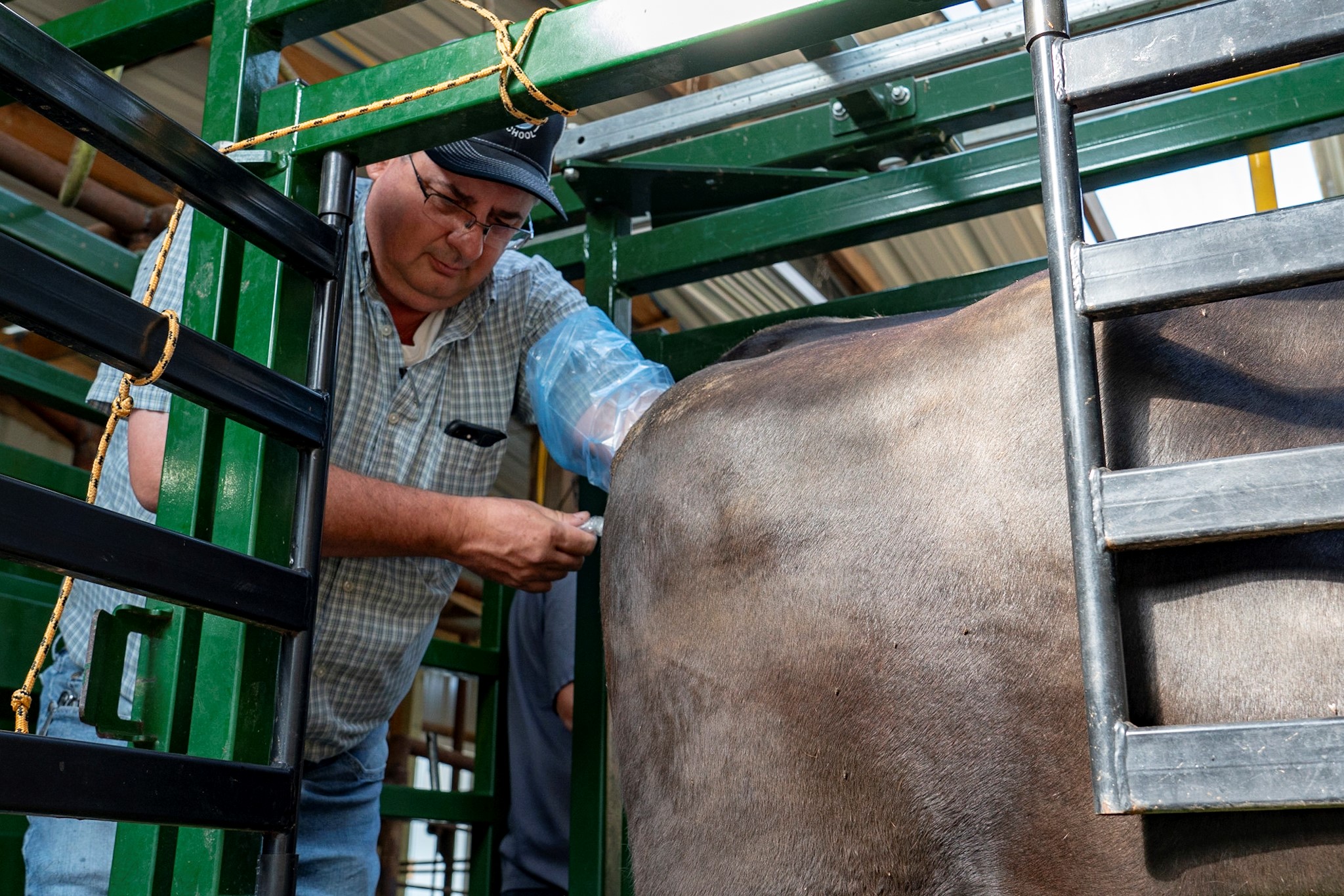
The Ovum Pick-up technique involves the transvaginal recovery of the oocytes by aspiration of the ovarian follicles with the aid of an ultrasound probe. This procedure is totally harmless for the donor and it takes about 15-20 minutes, during which the donor is contained in a cattle chute.
The recovered oocytes are selected in the laboratory and transferred in a medium suitable for the completion of maturation. The day after the collection, the oocytes are fertilized in vitro with the semen of the chosen bull and they are held in incubator for about a week until they reach the stage of suitable embryo (morula or blastocyst) for the transfer into recipients or for freezing and to be transferred at a later stage.
What You Will Learn in the OPU course:
- Physiological aspects of OPU / IVF
- OPU collection procedure in live animals
- Correct positioning of ovary & follicles during aspiration
- Oocyte searching and grading, extraction, washing / preparing oocytes (COCs) for shipment to the IVF lab for in-vitro maturation
- Choosing equipment
- Proper equipment assembly
- Equipment troubleshooting and testing
Class Size: Limited to 4 aspiration students &/or 4 lab students maximum (minimum 3 aspiration students) This ensures a high level of teacher/student interaction.
Instructors
All of our courses are taught by industry experts — instructors who perform AI, embryo transfer and OPU commercially, not just in the classroom. You learn the techniques the way they are actually done in the field, along with the practical advice that comes from years of doing the work.
Key Benefits of OPU

- Using OPU All heifers and cows are suitable donors. You can produce embryos from virgin heifers at the age of 10 months old. Additionally, since IVF does not involve the uterus, pregnant donors can still be collected throughout the first trimester of pregnancy, until day 100-120 of pregnancy, allowing producers to breed genetically valuable donors on time while still capitalizing on creating additional offspring.
- Donor aspirations (OPU) can be performed every two weeks, and semen from different bulls can be used to fertilize each donor, in the event enough oocytes are collected. Allowing the opportunity for greater genetic diversity resulting from one cow along with maximized embryo production.
- Can perform OPU on cows with unpassable cervix's
- Donor cows that have been unable to achieve success with embryo transfers due to blockages, scarring, uterine infections, impassable cervices, overstimulation or because they make unfertilized or degenerate embryos are also good candidates for IVF. On certain donors affected by long term infertility OPU can even have a therapeutic effect by removing the ovarian cysts that often are present on the ovaries, also as a consequence of repeated superovulations; in many cases those animals can be successfully inseminated after the OPU collection cycle.
- There is no need for hormonal treatment, no interference with milk production, nor possible side effects of superovulation (infertility, ovarian cysts, drop in milk production, trauma derived from altered behavior induced by hormonal superstimulation).
- On average 4-5 embryos can be obtained per collection in heifers and 6-8 for cows.
- Most donors return to oestrus 7-10 days after the last OPU collection.
- Using OPU/IVF producers can maximize oocyte fertilization and embryo production with rare, expensive or sexed semen. In advanced labs, only a piece of straw is needed to fertilize donors, not a full straw.
Course Syllabus
The OPU (Ovum Pick-up) Course is 2.5 days. We go into town each day for lunch.
-
Day 1
Lab & lecture
- Protocols, donor and recipient management, equipment, oocyte processing, and discussion — most of the day
Late afternoon · at the chutes
- Working on cows learning the equipment and placement of the needle guide for OPU
-
Days 2 & 3
Lab & lecture
- A couple of hours each morning
At the chutes
- The rest of the day in cows practicing probe placement, ovary manipulation, OPU, troubleshooting and all techniques needed to become proficient at aspiration
Note: Oocyte processing is the most important aspect of OPU and IVF success. Students will learn processing in the lab as well as OPU so they will know the correct method to teach their lab technicians or assistants.
Course Hours
- Days 1–2
- 8:00 AM – 5:00 PM
- Day 3
- 8:00 AM – 1:00 PM
Prerequisites
Students must be experienced in palpation, AI and embryo transfer or have taken the ET course with us.
School Location
Our facilities are located in Senatobia, Mississippi, 45 minutes south of Memphis International Airport. Students travel to us from all over the United States and from other countries. Many drive in from neighboring states; those who fly should book into Memphis International Airport, the closest airport to the school.
View Larger Map
Transportation & Lodging Info
Transportation and lodging are not included in the cost of the course. If you are flying, fly into Memphis International Airport and rent a vehicle — the school is about a 45-minute drive from the airport. Most students stay in Senatobia or Hernando; the casinos in Tunica are another option.
Hotels, rooms & RV parks near the school17 listings with drive times, phone numbers and websitesOvum Pick-Up (OPU) Course Schedule
Dates marked full are closed — call 662-562-0304 to be told when the next one opens.
Tuition

Registration
To register for this course click the below Register button, you will select the date you wish to attend on the registration form. You may add additional courses and products to your cart prior to checkout.
OPU students can bring their technician along for an additional $1,150 to learn the lab techniques. Technicians sit through the entire course but cannot take part in the arm-work labs.
How to book your lab technician: click the Register button below. On the registration form, select “Bringing a technician?” beside the OPU student's name and enter the technician's details. The $1,150 is added to your order automatically. One technician per OPU student.
Already enrolled? Log in to your account to add a lab technician, or contact us.

|
|
|