
Ranchers First: What USDA Announced, What's Still Just Talk, and What It Means If You're Keeping Heifers
Last Friday the President posted that four packers control beef processing and that he was authorizing legal documents to let farmers and ranchers process their own food. By Monday, Agriculture Secretary Brooke Rollins was at the Nebraska State Fair announcing a package she called Ranchers First. The headlines that followed ranged from "Big Four monopoly broken" to "ranchers freed to process." Neither is what happened.
What did happen is worth understanding, because one piece of it lands directly on the decision every cow-calf operation is making right now: keep the heifer, or sell her while she's worth more than she has ever been. Here is what was actually announced, what is still talk, and where your own breeding program fits in.
What USDA actually announced on August 31
The Ranchers First release names five actions. In plain language:
- BRAND heifer-retention insurance. A new endorsement to Livestock Risk Protection called Beef Retention and National Development. It would let you insure the economic value of holding a heifer back for breeding over a two-year period. More on this below, because it is the one item aimed squarely at rebuilding the herd.
- ECP on Grassland CRP acres. Emergency Conservation Program money can be used to rebuild fence and water on Grassland CRP ground after wildfire and other disasters.
- SPUR guaranteed loans and a regional processor effort. A guaranteed-loan version of the Strengthening Processing for U.S. Ranchers program, with processor co-ops named as a target, plus a "Regional Processor Continuity Effort." USDA's own release notes that recent plant closures mean nearly 20 percent of beef processing capacity will be sitting idle as the herd grows, and it wants that capacity in the hands of American-owned independents and co-ops.
- American beef in federal purchasing. Encouraging federal and state institutions such as prisons and hospitals to buy locally processed domestic beef, building on the Harvest to Hallways school-meal announcement.
- Beginning and veteran ranchers. A new focus on Beginning and Veteran Farmers and Ranchers Affairs, and recruiting departing service members into ranching through the Department of War's SkillBridge program.
Notice what is not on the list: a rule change that lets you sell uninspected beef. The processing promise is still a promise.
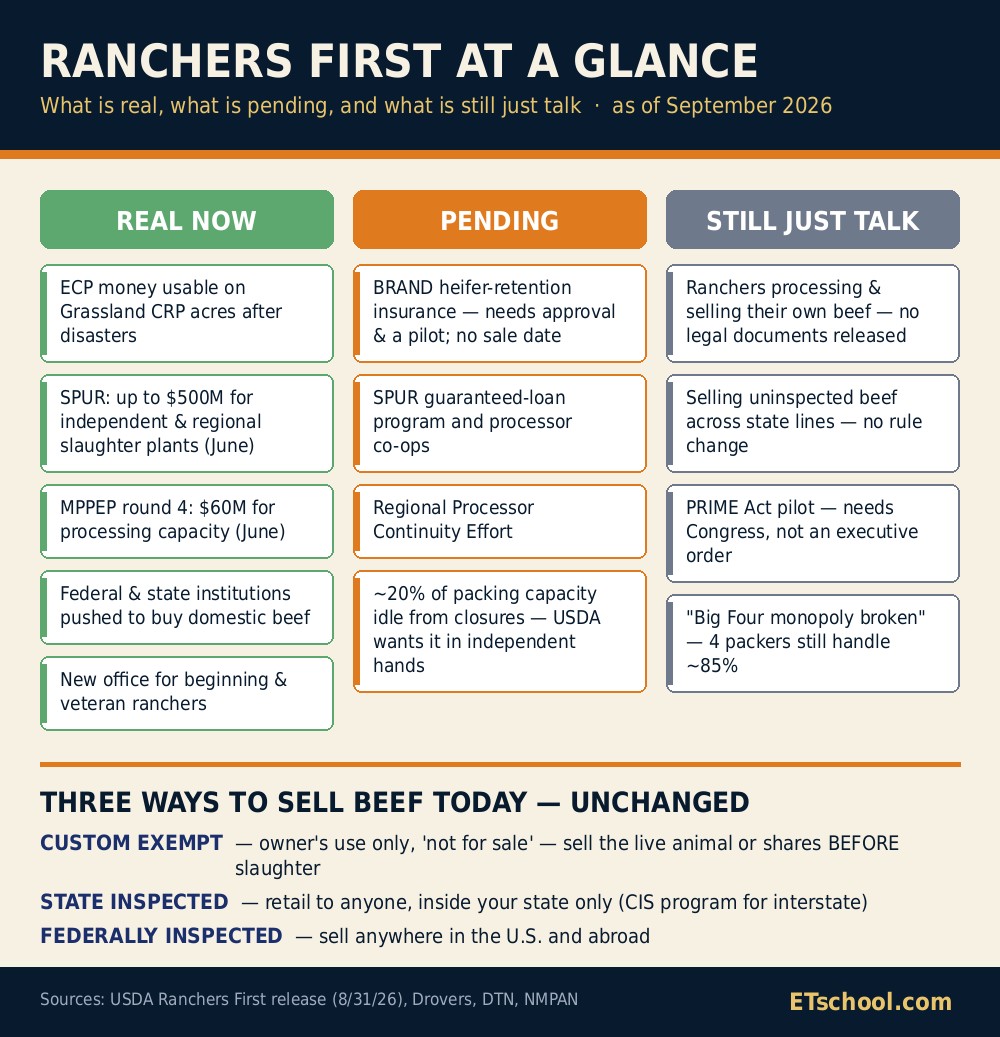 Ranchers First at a glance: what is real, what is pending, and what is still just talk — as of September 2026
The processing promise: what is real today
The President's post said he was "authorizing legal documents" so ranchers can process their own food. As of this writing no documents have been released, and it is not clear how far an executive action can go, because the inspection rules sit in the Federal Meat Inspection Act. The Meat Institute's reply, self-interested but accurate, was that producers already have paths to process and sell.
They do. There are three, and the difference between them is not how the animal is handled; it is who is allowed to buy the meat.
Custom exempt. You can have your own animal slaughtered and processed at a custom-exempt plant with no federal or state inspector present. The catch is in the name: the meat is for the exclusive use of the owner, is stamped "not for sale," and cannot be sold or even donated. The workaround most producers use is selling the live animal, or shares of it, before it goes to the plant, so the buyer owns the animal and the processor is working for them. Get the buyers on paper before the animal leaves your place.
State inspected. Roughly 27 states, Mississippi among them, run their own meat inspection programs, which by law must be at least equal to federal inspection. Meat from a state-inspected plant carries a mark of inspection and can be sold to anyone, at farmers markets, restaurants and stores, but only inside your state's borders. The exception is the Cooperative Interstate Shipment program, which lets qualifying state plants ship across state lines if the state and the plant both take part.
Federally inspected. A USDA inspector is present for every animal, the plant runs a HACCP plan, and the meat can go anywhere in the country and abroad. This is the path the Big Four run on, and it is also the path most small direct-marketers use when they can find a plant with an open slot.
The vehicle that would actually change the rules is the PRIME Act, a House farm bill pilot that would let states allow custom-processed meat to be sold directly to local buyers under state oversight. Its sponsor, Rep. Thomas Massie, welcomed the President's post and pointed out in the same breath that it needs to be a law, not an executive order. Watch that bill, not the social media feed.
BRAND: insurance for the heifer you keep
This is the piece that matters to a breeding operation, so it deserves a careful read.
The problem it targets is simple. A bred heifer is worth more today than she has ever been, and a feeder heifer is not far behind. Keeping her back means giving up a check you can see for calves you cannot see yet, and the last two Augusts have shown how fast a market can move against you. USDA's numbers put the national cow herd at a 75-year low, and until enough heifers are held back it cannot grow.
BRAND would work like this. At enrollment the policy establishes a protected value based on the heifer's expected slaughter value at that moment. If at any point over the following two years her projected or realized slaughter value exceeds what she is worth to you as breeding stock, the policy pays the difference. In other words, it insures you against being wrong about keeping her.
Two cautions. First, it is not on sale. Terrain analyst Don Close, quoted in Drovers, said a product like this normally needs testing, regulatory approval and a pilot before producers can buy it, and asked when it will be market-ready. Nobody has answered that yet. Second, the policy only makes the retention decision cheaper to get wrong. It does not make a retained heifer produce.
That last point is the whole game, and it is one Washington cannot help you with.
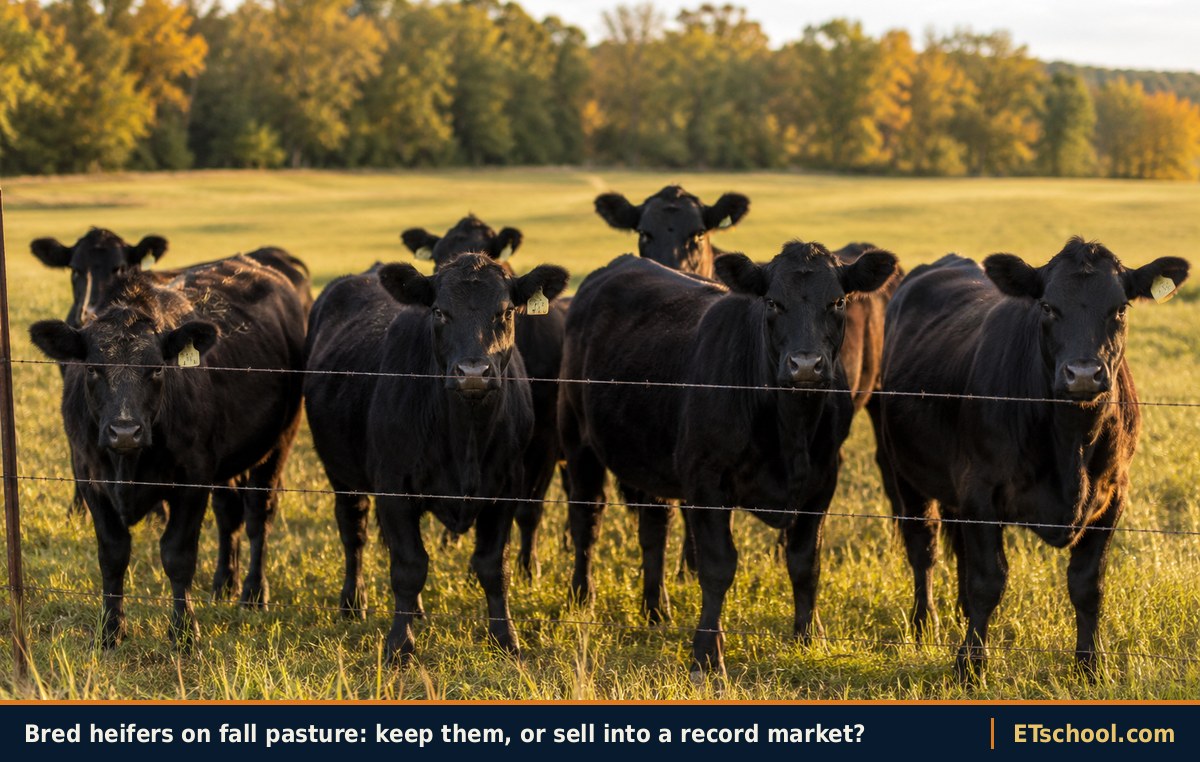 Retained heifers are only an investment if they breed early and calve on time
The part that is yours
Every plan announced this week, from BRAND to the new plants to the federal beef purchases, rests on one assumption: that ranchers will hold heifers back and rebuild the herd. The signals say it is starting, slowly. Heifers are still about 37 percent of cattle on feed, well above the 32 to 34 percent that has marked true expansion in past cycles, but the number has begun to move.
A retained heifer is a two-year bet. She costs you a sale now, eats for a year before she breeds, and does not put a calf on the ground until she is two. The return on that bet is decided by three things you control: whether she conceives early in her first season, whether she calves without help, and whether she breeds back on time as a two-year-old. Miss any of those and the insurance question becomes academic, because she will be a cull cow, not a cow.
That is why the producers coming out of this cycle ahead will be the ones who treat herd rebuilding as a breeding problem rather than a headcount problem. Retaining a heifer and turning her out with the neighbor's bull rebuilds numbers. Retaining a heifer and breeding her by artificial insemination to a proven calving-ease sire, in a synchronized group so she calves in the first three weeks, rebuilds a herd that is better than the one you lost. And if you are rebuilding from a small base, embryo transfer lets one outstanding cow contribute a dozen replacement heifers instead of one, which is the fastest legal way to close a genetics gap while the numbers come back.
Both skills are learnable, and you do not need a veterinary degree to learn them. Our Bovine Artificial Insemination Training Course is a day and a half of hands-on work on live cows with no prior experience required. The Comprehensive Bovine Embryo Transfer Training Course is the next step for anyone already competent at AI. If you are starting from scratch and want both, the Combined AI and Embryo Transfer course covers both in one trip, with no prior experience required. We have been teaching producers to breed their own cattle for over 35 years, and the skill you learn is yours for the life of your operation, whatever Washington does next.
What to do this fall
- Keep selling beef the way you legally can now. Custom exempt for shares sold before slaughter, state inspection for in-state retail, federal for everything else. Do not change your marketing on the strength of a social media post.
- If you direct-market, watch SPUR and the co-op push. A regional plant or processor co-op within an hour of you would change your economics more than any rule change. Talk to your state cattlemen's association about what is forming.
- Make your heifer decision on your own numbers, not on BRAND. Pencil out the retained heifer at today's prices with and without a two-year backstop. If it only works with the insurance, it does not work yet, because the insurance does not exist yet.
- If you keep her, breed her like she matters. Synchronize, use AI on a calving-ease sire, and get her bred in the first 21 days. That is the single biggest lever on whether she is a cow or a cull at three.
- Learn the skill before you need it. Every month you wait is a breeding season you are paying someone else for.
References
- USDA press release: Secretary Rollins Announces Ranchers First Initiatives to Rebuild the Great American Beef Herd (Aug 31, 2026)
- Drovers: Ranchers First Initiative Aimed at Herd Rebuilding, Processing and Risk Management
- DTN/Progressive Farmer: Trump Wants Farmers, Ranchers to Process Their Own Beef to Challenge Big Four Packers
- Agri-Pulse: Trump goes after Big Four meatpackers
- Brownfield Ag News: USDA beef plan targets price risk and producer confidence
- Niche Meat Processor Assistance Network: Meat Regulations for Producers
- Texas A&M Agricultural Law: Can I Sell State Inspected Meat Across State Lines?
- Our earlier article: More Imported Beef, Lower Cattle Prices

|