
Screwworm Watch: Where the Outbreak Stands in August 2026 — and What Producers Should Do Now
The New World screwworm is back on American soil for the first time in roughly 60 years. On June 3, 2026, USDA confirmed screwworm larvae in the navel of a three-week-old calf in Zavala County, Texas. Since then the response has moved fast, and so has the news. Here is where things stand as of mid-August, and what it means for your herd.
Where the Outbreak Stands
Since June, 45 cases have been confirmed in Texas and New Mexico. The encouraging part: as of mid-August, only 4 of those remain active. The largest cluster has been Crockett County, Texas, with 11 confirmed cases. Every detection triggers the same playbook: the animal is treated, the premises quarantined, surveillance and trapping expand around the site, and sterile flies are concentrated over the area.
For background on what the screwworm is and why it threatens breeding programs specifically, see our earlier article, Screwworm Outbreak: Implications for Reproductive Programs and Herd Health.
Sterile Flies by the Millions
The sterile insect technique wiped screwworm out of this country once, and it is the backbone of the response again. Since June 4, aircraft flying out of Moore Air Base in Edinburg, Texas have been releasing about 2 million sterile flies twice a week over the infested zones, backed by roughly 4 million a week in ground releases. Across the wider program, more than 100 million sterile flies a week are being dispersed from facilities in Panama and Mexico.
More capacity is coming. Construction of the new domestic production facility has been accelerated, with an opening now targeted for spring 2027 and output of 300 million flies a week by the end of 2028 - part of a network goal of roughly 500 million sterile flies a week.
The Border Reopens August 24
Cattle imports from Mexico have been shut down since the outbreak began, and that is about to change. The Douglas, Arizona port of entry is scheduled to reopen August 24, 2026 on a phased basis. Every animal will be inspected before crossing, with volume eventually building to as much as 80,000 head a month. Officials note the nearest active Mexican case is about 325 miles from the border. Expect feeder supplies and prices to react as those imports resume.
Two New Treatments Approved
Producers now have screwworm-specific options on the shelf. FDA has granted conditional approvals to Dectomax-CA1, a doramectin injectable, and Exzolt Cattle-CA1, a fluralaner pour-on, for use against screwworm in cattle. Talk with your veterinarian about where these fit in your treatment and prevention plan.
What This Means for Your Breeding Program
Screwworm flies lay eggs on fresh wounds and mucous membranes - and a breeding operation creates exactly those openings on a schedule. Newborn navels, calving injuries, tagging, injections, dehorning and castration sites are all invitations during fly season. That is why the first U.S. case was found in a newborn calf's navel. The outbreak does not have to reach your county to matter, either: quarantines and movement controls follow every detection, and they are hardest on operations moving donors, recipients and calves between locations.
The good news is that the same discipline that makes a reproductive program successful - frequent handling, close observation, good records - is precisely what catches screwworm early.
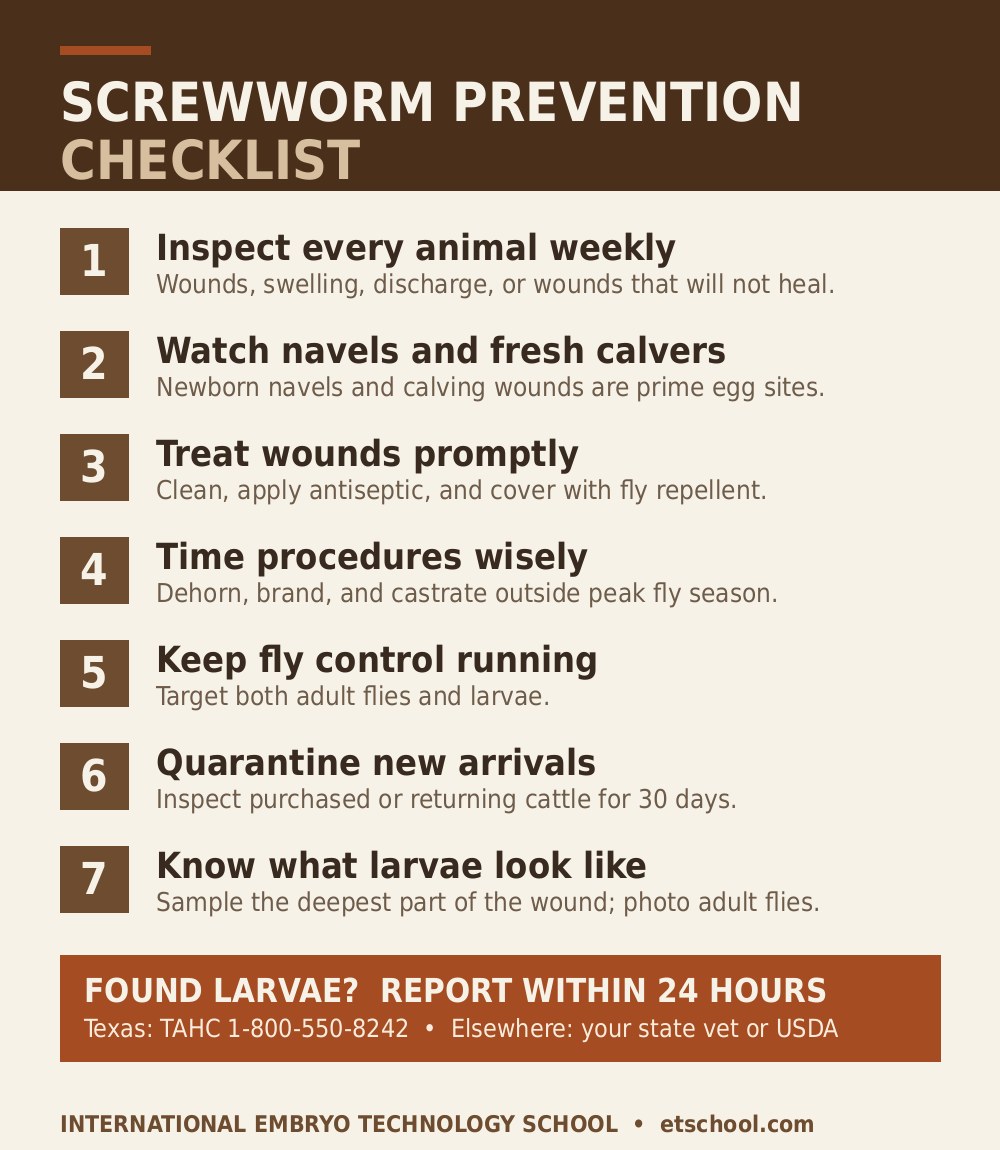 Save or print this checklist and keep it at the chute through fly season.
Your Prevention Checklist
- Inspect every animal at least weekly. Look for wounds, swelling, discharge, and any wound that smells bad or grows instead of healing.
- Watch navels and fresh calvers closely. Newborn navels and calving wounds are prime egg-laying sites - check them daily during fly season.
- Treat every wound promptly. Clean it, apply an antiseptic, and cover it with a fly repellent until it heals.
- Time procedures wisely. Where you can, schedule dehorning, branding and castration outside peak fly activity.
- Keep fly control running. Use a program that targets both adult flies and larvae, and keep it going late into the season.
- Quarantine new arrivals. Inspect purchased or returning cattle closely for at least 30 days before they join the herd.
- Know what you are looking for. Larvae from the deepest part of the wound are what a lab needs; photograph any suspicious adult flies.
Healthy Herds, Skilled Hands
The producers who come through events like this best are the ones with their hands on their cattle the most. For over 35 years the International Embryo Technology School has trained cattle producers and veterinarians to do exactly that. If adding reproductive skills is on your list, our Comprehensive Bovine Embryo Transfer Training Course covers flushing, freezing and transfer (competence in AI is required), our Bovine Artificial Insemination Training Course builds AI skills in a day and a half, and our Combined AI & ET Training Course takes beginners through both.
References

|