
Chart: Know Your Calving Dates Before the Season Starts

If you know the day she was bred, you already know — within a narrow window — the day she will calve. That one piece of information drives half the management decisions on a cow-calf operation: when to vaccinate, how to feed the third trimester, when to start night checks, and when the calf crop will be ready to market. This article gives you the 283-day rule, a printable gestation chart built on it, and how to put exact dates to work.
How Long Is a Cow Pregnant?
The standard answer is 283 days — a little over nine months. Most Bos taurus females calve inside a range of roughly 279 to 287 days, and breed moves the average around more than anything else: Holsteins run short at about 279 days, Angus around 281-283, Herefords closer to 286, and some Continental breeds like Limousin push 289-291. Brahman-influenced cattle carry noticeably longer — about 10 days past the taurus average, with 292-293 days being normal.
A few smaller effects are worth knowing. Bull calves are typically carried 1 to 2 days longer than heifer calves. First-calf heifers tend to calve a shade earlier than mature cows. And recent multi-year data on Bos taurus beef cows put the true modern average nearer 280 days, with fall calvers running a day or two shorter than spring calvers — one more reason to treat any due date as the center of a window, not an appointment.
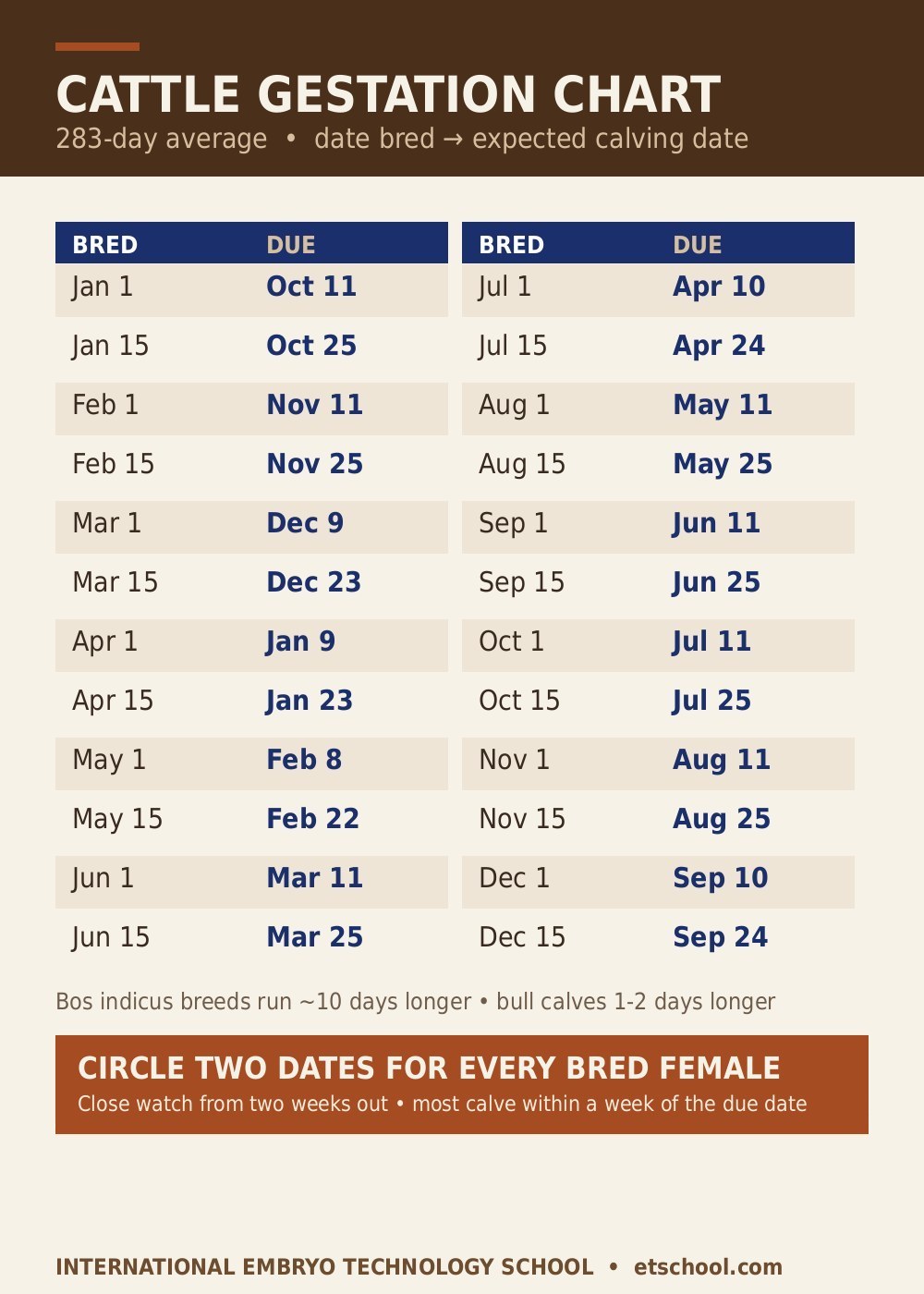 Print this chart and pin it where you keep your breeding records.
How to Read the Chart
Find the breeding date, read across, and that is the expected calving date 283 days later. For dates between the chart rows, the arithmetic shortcut is: same calendar day nine months later, plus about ten days. A cow bred May 10 is due around February 17; one bred November 15 is due around August 25.
Then remember the window. On the 279-287 day spread, a due date is the middle of roughly a week either side — which is exactly why the close watch starts two weeks out, not the night before.
Exact Dates Are an AI and ET Advantage
With a bull turned out for 60 or 90 days, every cow's due "date" is really a two- or three-month guess. Artificial insemination flips that: every AI'd female has a breeding date recorded to the day, and every recipient carrying an embryo transfer calf has an implant date just as exact. That precision is what makes the chart genuinely useful:
- Time pre-calving vaccines properly. Scours vaccines and boosters have recommended windows keyed to the calving date — exact dates let you hit them instead of guessing.
- Feed the last trimester right. Around 70 percent of fetal growth happens in the final 90 days, so knowing who is due when lets you sort and feed heavies to condition without overfeeding the rest.
- Stage the calving area. Move close-up females to the calving pasture and start checks two weeks before their date — not for the whole season.
- Plan labor and marketing. Tight, known calving windows mean a uniform calf crop you can work, wean and sell as one group.
Planning Backward: Pick the Calving Window First
The chart works both directions. Decide when you want calves on the ground, then count 283 days back to set the breeding date. Want the first calves around March 1? Breeding needs to start around May 22. Targeting mid-September fall calves? Turn-in is around December 6. A controlled breeding season is what produces a controlled calving season — set the front end and the back end follows.
Skills That Make the Chart Work Harder
Everything above starts with knowing the breeding date exactly, and that is a skill your own hands can learn. For over 35 years the International Embryo Technology School has trained cattle producers and veterinarians to run their own breeding programs. Our Bovine Artificial Insemination Training Course teaches AI hands-on in a day and a half with no prior experience required; the Comprehensive Bovine Embryo Transfer Training Course adds flushing, freezing and transfer for those already competent at AI; and the Combined AI & ET Training Course takes you from beginner through both in one week.
References

|