
Why Do Cows Come Up Open? The Eight Most Common Causes
There is no worse sound on preg-check day than the vet saying "open" three times in a row.
First, some perspective. A few opens are normal, and they are not entirely bad news - they put a little selection pressure on fertility and cull the females that do not fit your environment. Illinois Extension puts the threshold plainly: in a defined 60 to 90 day breeding season, once you get past roughly 6 to 10 percent open, it stops being normal attrition and starts being a problem worth diagnosing.
The frustrating part is that preg-check is an autopsy. Whatever went wrong happened months ago, and the chute only tells you the result. So the useful exercise is working backward through the eight things that cause nearly all of it.
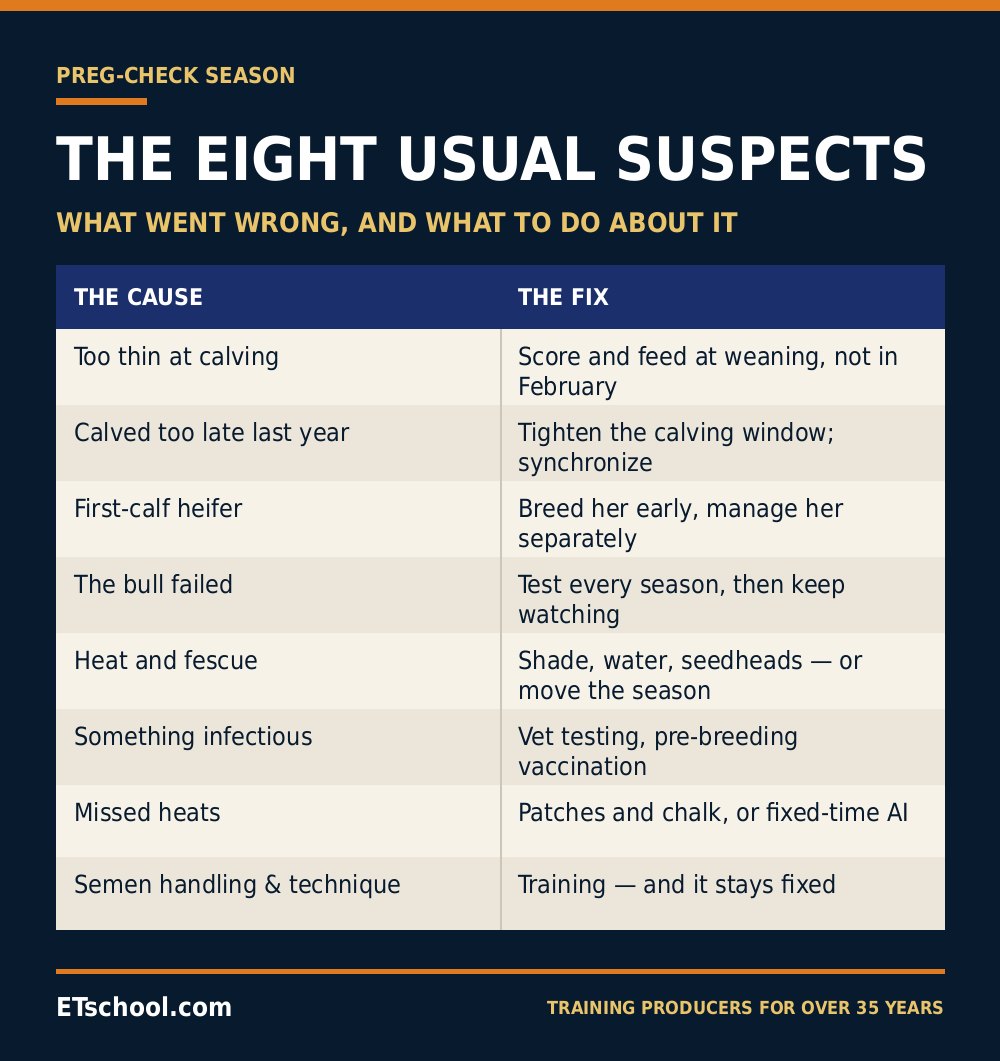 The eight usual suspects, and what to do about each.
1. She was too thin at calving
This is the biggest one, and it is not close.
A cow's body condition at calving - not at breeding - largely determines how quickly she starts cycling again afterward. Research going back decades shows cows at a body condition score above 5 breed earlier and are more likely to conceive and stay pregnant. Thin cows at calving do not breed back well, no matter how good the grass is by June. One Virginia Tech extension veterinarian estimated that a herd starting the grazing season a full condition score below normal would see roughly 5 percent more opens.
The direction matters as much as the number. A cow losing weight during breeding often will not conceive, or will not hold the pregnancy, even if her score still looks acceptable on the day. A cow at a 5 and gaining beats a cow at a 5 and falling.
The fix: score cows at weaning, not in February. Weaning is the cheapest moment in her whole year to add condition, because she is dry and her requirements are at their lowest. Waiting until she is thin, lactating and cold is how a manageable problem becomes an expensive one.
2. She calved too late last year
A cow needs time to get her uterus back, resume cycling, and settle - and that clock starts at calving, not at turnout.
A cow that calved in the last two weeks of your calving season may only be 30 or 40 days postpartum when the bull goes out. She may not have cycled at all yet. She either breeds very late in the season or comes up open, and if she breeds late she calves late again next year and is even further behind. The problem compounds until she falls out of the herd.
The fix: this is one of the strongest arguments for a tight calving window and for synchronization. Every cow you pull forward into the front of the calving season is a cow with a full postpartum interval before the next breeding.
3. She was a first-calf heifer
Two-year-olds are the hardest females on the place, and they are usually over-represented in the open list.
She is still growing while lactating for the first time, which means she is being asked to do three jobs at once. Anything that lengthened her recovery makes it worse - and calving difficulty is the classic one. Nebraska Extension notes that heifers that had a hard calving have a longer postpartum interval and show up as opens more often.
The fix: develop heifers to roughly 60 to 65 percent of mature body weight by breeding, breed them ahead of the mature cows so they get extra recovery time, use genuine calving-ease sires, and manage them as a separate group after calving rather than running them with the mature cows.
4. The bull failed
Bull failure is a constant cause of reproductive loss, and the worst part is how quiet it is. A bull that quits in week two of a 60-day season can leave two-thirds of a group open and nothing looks wrong from the road.
Two things producers routinely miss here. First, a breeding soundness exam is a snapshot in time, and because sperm production is roughly a 61-day process, an injury or illness that happened weeks before the exam may not show up in it yet. Second, a BSE does not measure libido - a bull can pass every measurement and still not work.
The fix: test every bull before every season, and then keep watching. Check feet, legs, sheath and scrotum during the season. Watch that he is actually breeding. Have a spare, and use it the day you have a doubt rather than the week after. And run enough bull power for the number of cows and the terrain.
5. Heat and fescue
Breeding in summer costs conception, and in the fescue country of the mid-South you are usually fighting both problems at once. Heat stress reduces conception directly, and toxic endophyte in tall fescue makes cattle run hotter, hold their hair coats, seek shade instead of graze, and breed poorly.
The fix: shade and water where cows actually stand. Manage seedheads. Consider whether your breeding season sits in the worst weeks of the year - this is one of the real arguments for fall calving in the Southeast, since it puts breeding in the cool months. And note that embryo transfer holds up better than AI under heat stress, because a transferred embryo skips the vulnerable early window.
6. Something infectious
If a group that was cycling normally comes up mostly open, or you see cows cycling after the breeding season ended, suspect early embryonic loss or abortion rather than failure to breed.
Trichomoniasis, BVD, leptospirosis, vibriosis and neospora all show up as open cows or as pregnancies that quietly disappear. Trich in particular can move through a herd through a single carrier bull.
The fix: this one is not a do-it-yourself diagnosis. Your veterinarian can test for it, and a pre-breeding vaccination program timed 30 to 60 days ahead of breeding prevents most of it. Biosecurity on incoming animals matters more than people think - most of these arrive with a purchase.
7. Missed heats and mistimed breeding
If you are breeding AI, a proportion of your opens never got bred at the right moment.
Standing heat is short, a good share of it happens overnight, and cows in a small group express it less. Miss the window and the cow is open for another 21 days at best.
The fix: observe at least twice a day for at least 30 minutes at a time, use tools rather than eyes alone - patches, tail chalk, activity monitors - and follow the AM/PM rule. Or take the timing question off the table entirely with a fixed-time AI protocol, which is exactly why synchronization exists.
8. Semen handling and technique
This is the one people are least willing to look at, and it is more common than anyone admits.
Thaw temperature and time, how long the straw sits before it goes in, cold shock on the walk to the chute, tank management that has slowly cooked an inventory, depositing in the wrong place - every one of these turns viable semen into an open cow. So does a rough job that traumatizes the tract.
Handling after breeding counts too. Move cattle within about five days of breeding, or wait until 45 days - moving them in between raises embryonic loss.
The fix: this is a training problem, and training fixes it permanently.
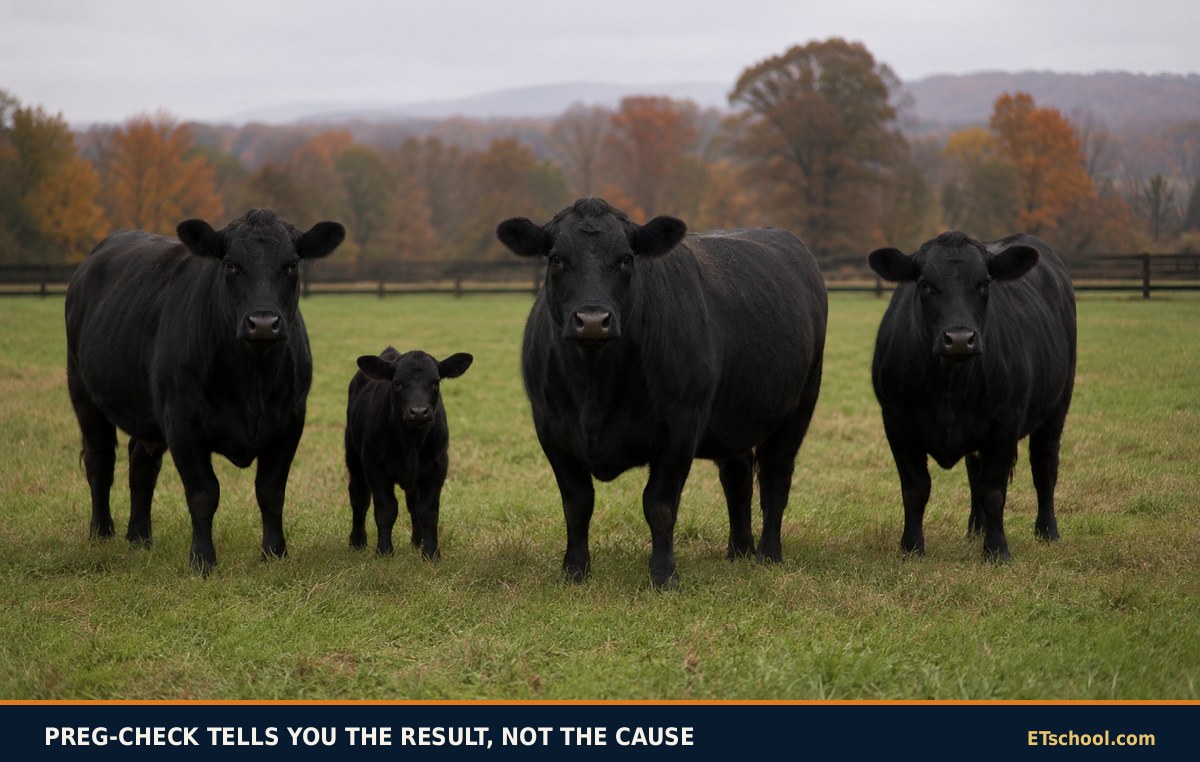 By preg-check, whatever went wrong has been done for months.
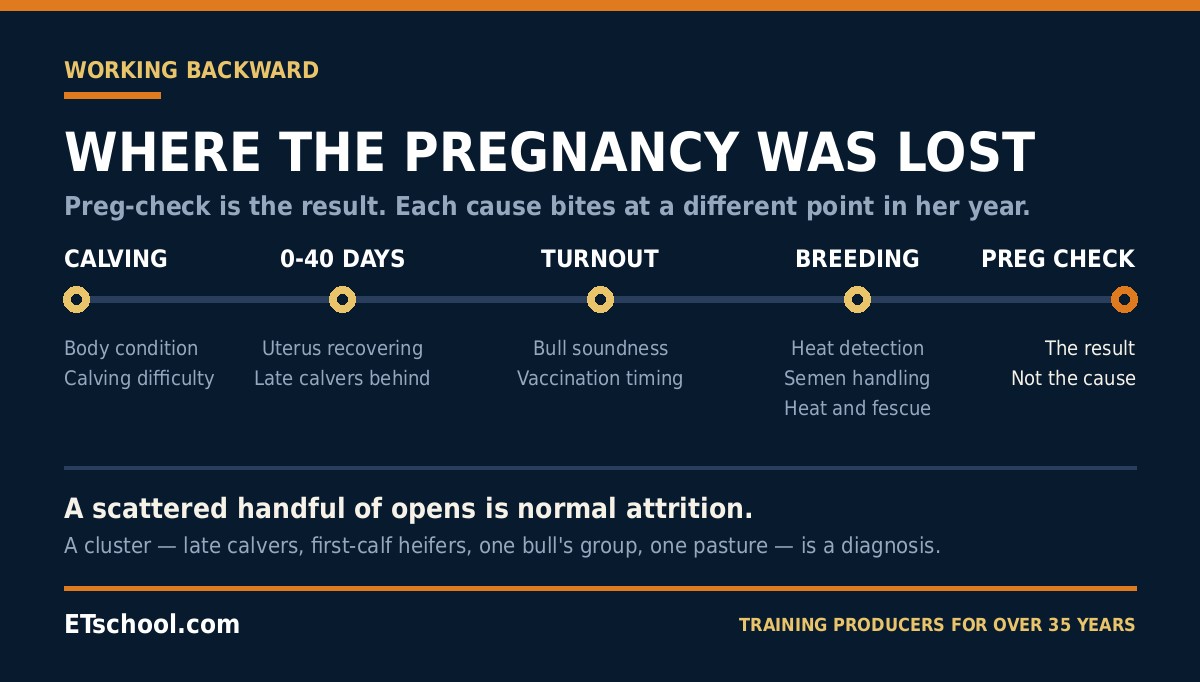 Each cause bites at a different point in her year.
Where training changes the picture
Look back at the list. Causes 2, 7 and 8 - postpartum interval, heat detection, and semen handling and technique - are all directly addressed by knowing how to breed cattle yourself. Cause 5 has an embryo transfer answer. That is half the list.
You don't need to be a veterinarian to take our courses. The International Embryo Technology School has been training producers, herdsmen, technicians and veterinarians for over 35 years, and our courses are open to anyone 18 or older.
- The Bovine Artificial Insemination course has no prerequisites and requires no prior experience. It covers the estrous cycle, heat detection, synchronization protocols, semen handling and technique - which is to say most of this article - with hands-on work on live cattle.
- The Comprehensive Bovine Embryo Transfer course is 4.5 days of hands-on training for students already competent at AI. Veterinarians and veterinary technicians can earn RACE-approved continuing education credit on this course.
- The Combined AI and Embryo Transfer course covers both, in order, for students starting from scratch.
You will learn a skill you can use on your own herd and, in some states, offer as a service - the rules vary by state, so check yours.
Open cows are information. The herds that improve are the ones that read them.
References
- Why are my cows open?, University of Illinois Extension
- Reproductive Health, University of Illinois Extension
- Why Do I Have So Many Open Cows?, Angus Beef Bulletin
- Too Many Open Cows?, Virginia Cooperative Extension
- Body Condition Scoring of Beef Cattle, University of Missouri Extension
- Pregnant cows and open cows, University of Nebraska-Lincoln Beef

|