
OPU vs Conventional Flushing in Cattle: Which Embryo Program Fits Your Operation?
Ask ten cattle people about embryo work and you will hear two different words: flushing and OPU. Both produce embryos from your best cows. They get there very differently, cost differently and suit different operations.
Here is how they compare, head to head.
What is conventional flushing?
Conventional embryo flushing - sometimes called MOET, for multiple ovulation and embryo transfer - works inside the cow. The donor gets a course of follicle-stimulating hormone (FSH) so she ovulates many eggs instead of one, she is bred by AI, and about seven days later the embryos are washed out of her uterus with a non-surgical flush. They are found and graded under a microscope, then transferred fresh into synchronized recipients or frozen.
Worldwide, a flush averages about 8.8 ova and 5.7 transferable embryos, according to the International Embryo Technology Society's 2024 figures. That average hides a wide range - some cows give twenty, some give none. A donor can generally be flushed about every 60 days.
What is OPU in cattle?
Ovum pick-up, or OPU, works outside the cow. Using an ultrasound-guided needle through the vaginal wall, the practitioner aspirates immature eggs (oocytes) straight from the follicles on her ovaries. The oocytes go to a lab, where they are matured, fertilized - this is bovine IVF - and cultured for about a week until they are embryos ready to transfer.
OPU can be repeated every one to two weeks, and over time it typically produces three to four times more transferable embryos than superovulation and flushing.
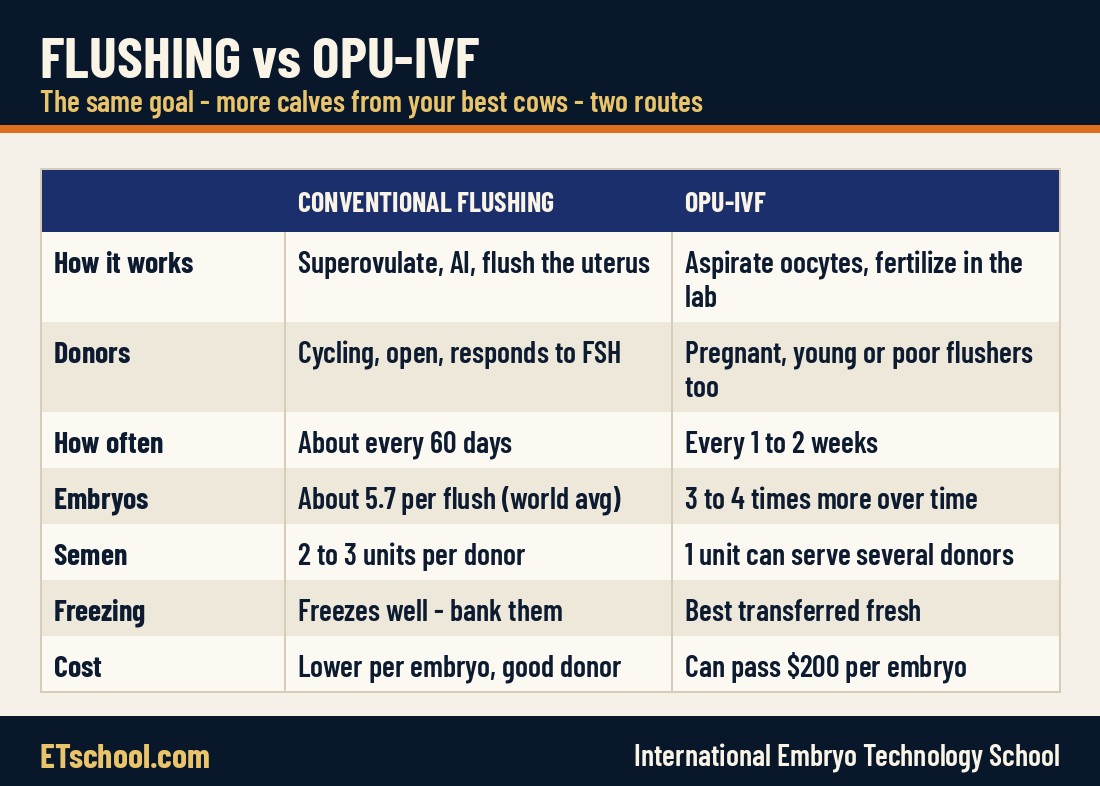 Conventional flushing and OPU-IVF, side by side.
Which donors suit each method?
This is often what decides it.
- Flushing needs a cycling, open donor that responds to FSH. Plenty of good cows fit, and for those cows flushing is proven, simple and economical per embryo.
- OPU works on donors flushing cannot use: cows in early pregnancy, young heifers before puberty, and cows that respond poorly to superovulation or have trouble with the flush.
Semen: where OPU saves money
A conventional flush usually takes two to three units of semen per donor. With IVF, one unit can fertilize oocytes from several donors, and you can use different bulls on one cow's oocytes in the same session. That makes bovine IVF the natural home for expensive sires and sexed semen - it is no accident the two grew up together.
What they cost
Flushing: published price lists put collection around $250 per donor, plus $45 to $75 per embryo to process, freeze or transfer fresh, plus drugs and synchronization.
OPU-IVF: aspiration commonly runs $250 to $300 per donor, and the lab's IVF fee comes on top - upwards of $400 in one extension comparison - which can push the cost past $200 per embryo once semen is added.
So flushing is usually cheaper per embryo on a donor that flushes well. OPU wins on donors that flush poorly, and on speed: more sessions a year means more embryos a year.
Fresh or frozen?
This is the practical catch with IVF. IVF embryos tolerate freezing less well than flushed embryos, so fresh transfer is preferred - which means a group of recipients synchronized and ready on the day the lab says the embryos are. Flushed embryos freeze well, so you can bank them and transfer when it suits you.
Where the industry is heading
IVF is now the dominant technology in cattle worldwide. The IETS counted in vitro embryos outnumbering flushed embryos about five to one in 2023, and transfers of IVF embryos rose another 10.6% in 2024. But conventional flushing has not gone away. Flushed embryos are still the ones that freeze, store and ship most easily, and on a donor that responds they are still the cheapest.
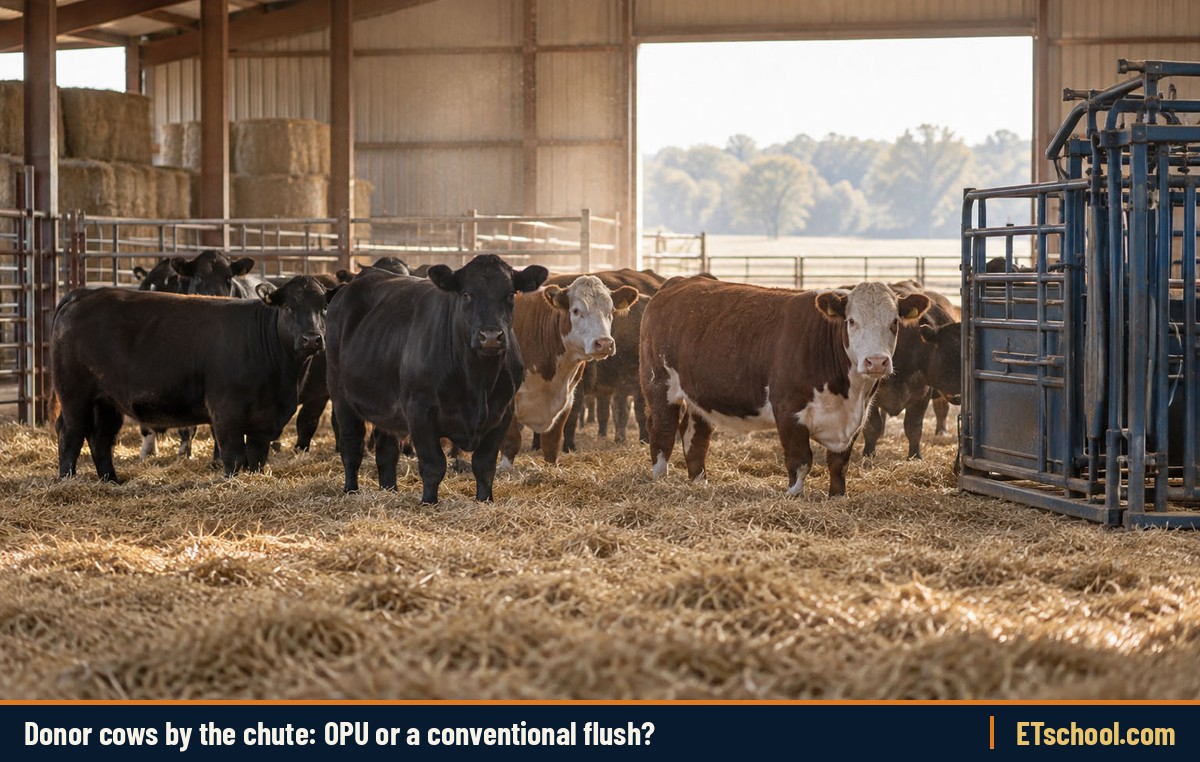 Donor cows on collection day.
So which fits your operation?
- Choose conventional flushing if your donors cycle and respond, you want embryos you can freeze and use later, and you would like to do the work yourself.
- Choose OPU-IVF if your best female is pregnant, young or a poor flusher; if you are using expensive or sexed semen; or if you need the most embryos per year and have recipients ready for fresh transfer.
- Many seedstock programs use both - flush the cows that respond, aspirate the ones that don't.
Learn the work yourself
The International Embryo Technology School has been teaching embryo transfer for over 35 years. You don't need to be a veterinarian to take our courses - they are open to anyone 18 or older.
- Our embryo flushing and transfer course - the Comprehensive Bovine Embryo Transfer course - is 4.5 days of hands-on training in superovulation, flushing, embryo grading, freezing and transfer, for students already competent at AI.
- Our OPU in cattle course is our most advanced, for people with palpation, AI and embryo transfer experience, or who have taken our embryo transfer course. Most of its students are veterinarians, though that is not required.
- Starting from scratch? The Combined AI and Embryo Transfer course covers AI and embryo transfer in order, with no prior experience required.
You will learn a skill you can use on your own herd and, in some states, offer as a service - the rules vary by state, so check yours.
References
- 2024 Statistics of Embryo Production and Transfer in Domestic Farm Animals, IETS
- Reproductive strategies for dairy herd improvement: MOET or OPU-IVF?, Progressive Dairy
- In Vitro Fertilization and Embryo Transfer: A Comparison, Trans Ova Genetics
- Development of the world farm animal embryo industry over the past 30 years, Theriogenology
- Cow Pricing, Champion Genetics
- Conventional Embryo Transfer, Bishop Reproductive Services
- Bovine Division Pricing, ReproLogix

|