
Liquid Nitrogen Semen Tank Care: Protecting Thousands of Dollars of Semen and Embryos
A liquid nitrogen tank holds your semen and embryos at about minus 320 degrees Fahrenheit. It does that with no power, no moving parts and no alarm. When a tank fails, it gives little warning, and straws that warm up cannot be saved. Add up what you paid for the semen and embryos in your tank. For most owners the figure is in the thousands of dollars, and some of those genetics cannot be bought again.
This article covers the checks and handling habits that protect that inventory.
How does a semen tank work?
A semen tank is two metal shells, one inside the other, joined at the neck. The space between the shells is a vacuum, and the vacuum is the insulation. As long as the vacuum holds and there is liquid nitrogen in the bottom, the inside stays cold enough to store semen and embryos for years.
Two things end that: the nitrogen runs out, or the vacuum is lost. Almost every tank failure is one of the two.
Inside the tank, the canisters hold the canes of semen and embryo straws. They sit in a spider on the bottom of the tank, which keeps each one in its place. Each canister has a straight handle that runs up through the neck and hooks over the rim, so you can lift one canister without disturbing the others. The diagram below shows the parts.
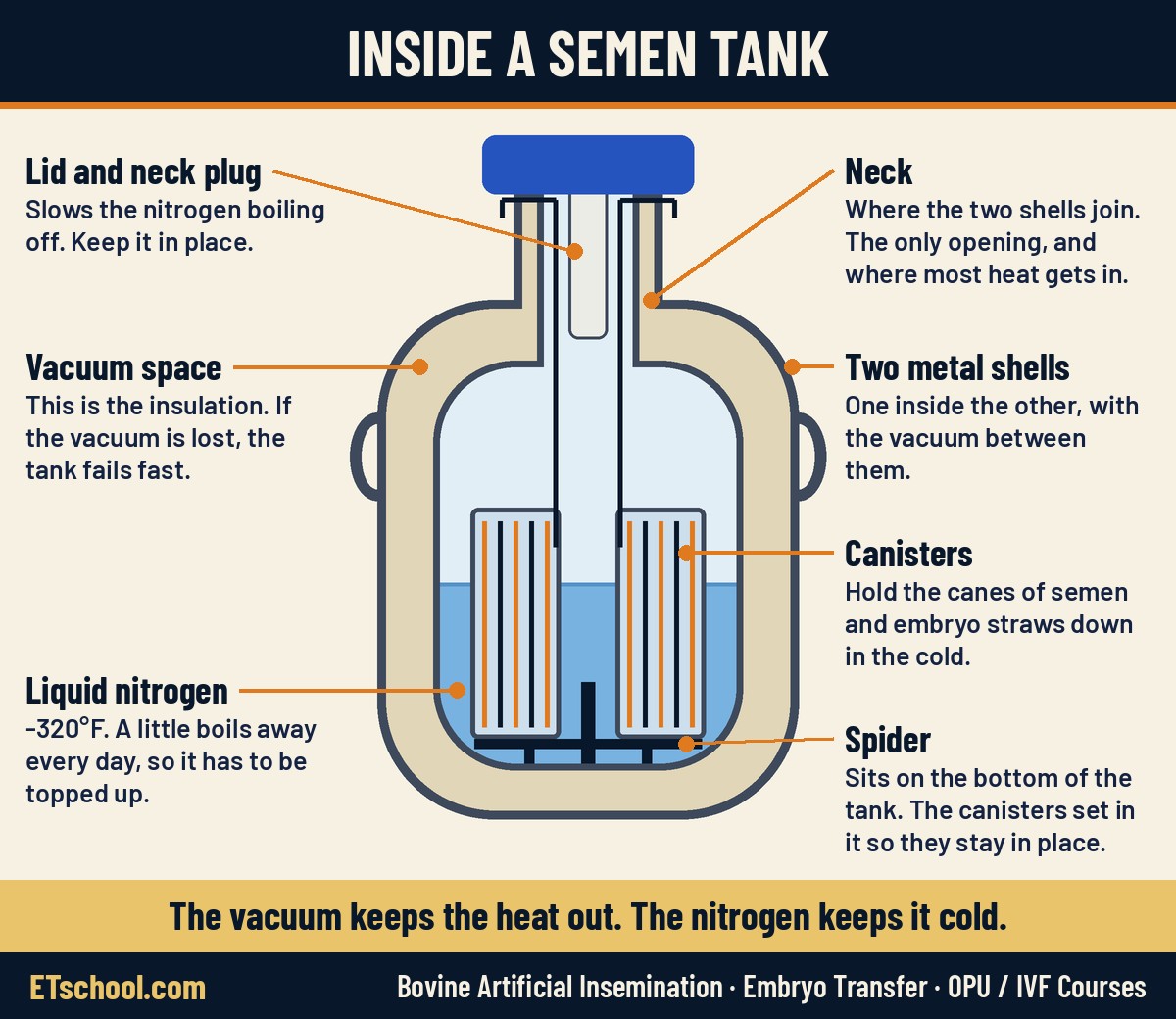 The parts inside a semen tank
How often should you check the nitrogen level in a semen tank?
Check it every week, and write the reading down.
- Use a wooden or plastic measuring stick. Never use metal, and never use a hollow pipe, which will spray liquid nitrogen out of the top.
- Lower the stick to the bottom of the tank and let it cool for a few seconds.
- Pull it out and wave it in the air. Frost forms on the part of the stick that was in the liquid nitrogen. The top of the frost is the nitrogen level.
- Write down the date and the depth.
The photos below show a weekly check on one of our own tanks. The tank sits on a rubber mat, which keeps the bottom off the bare concrete. After the stick is dipped and pulled out, the frost stops at about 28 centimeters. That is how deep the nitrogen was that day, and that is the number to write down.
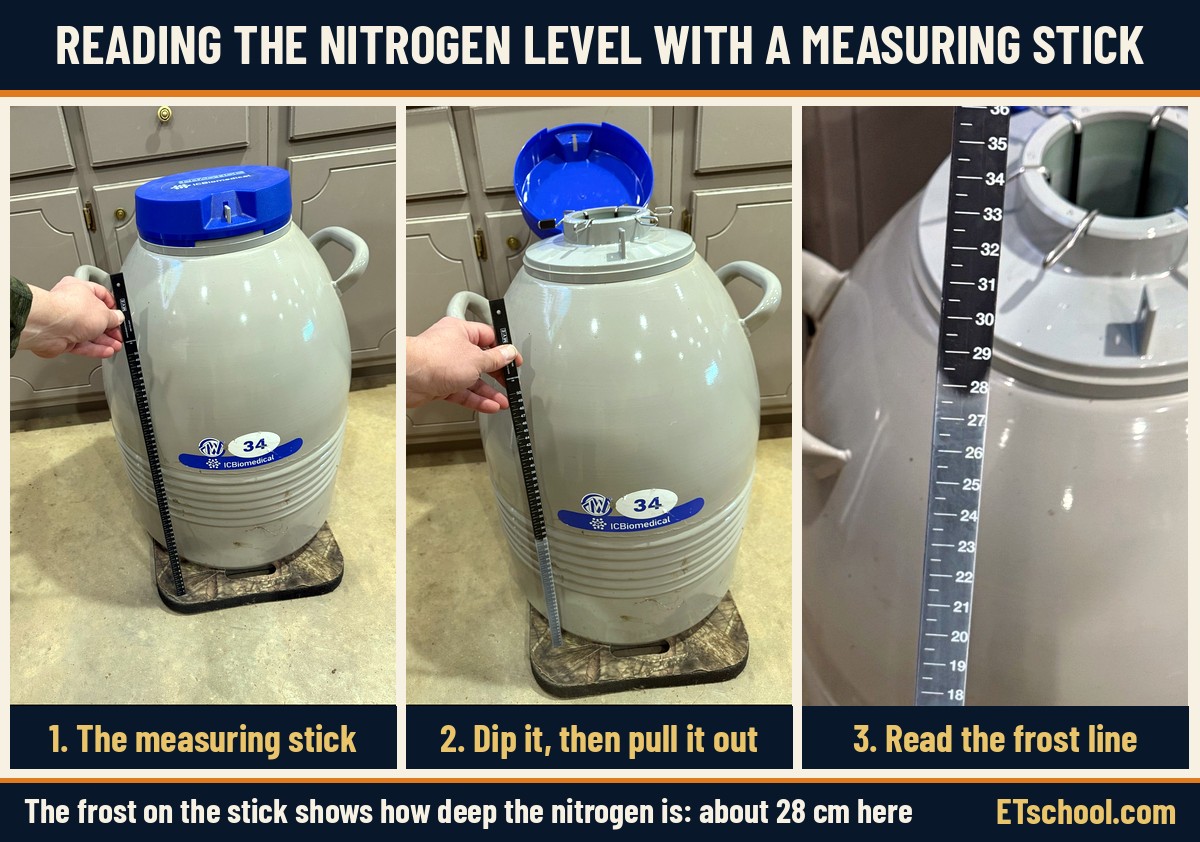 Checking the nitrogen level with a measuring stick. The frost line shows the depth.
The written record matters as much as the reading. Every tank loses nitrogen at a steady rate that depends on its size, its condition and how often it is opened. One manufacturer's example is a tank that loses about 0.09 liters a day and holds for 142 days. If your tank starts dropping faster than its own record shows, the vacuum is weakening, and you have found that out weeks before the tank goes dry.
Refill before the level reaches the minimum your tank's manufacturer gives. Do not stretch the time between fills to save a delivery fee.
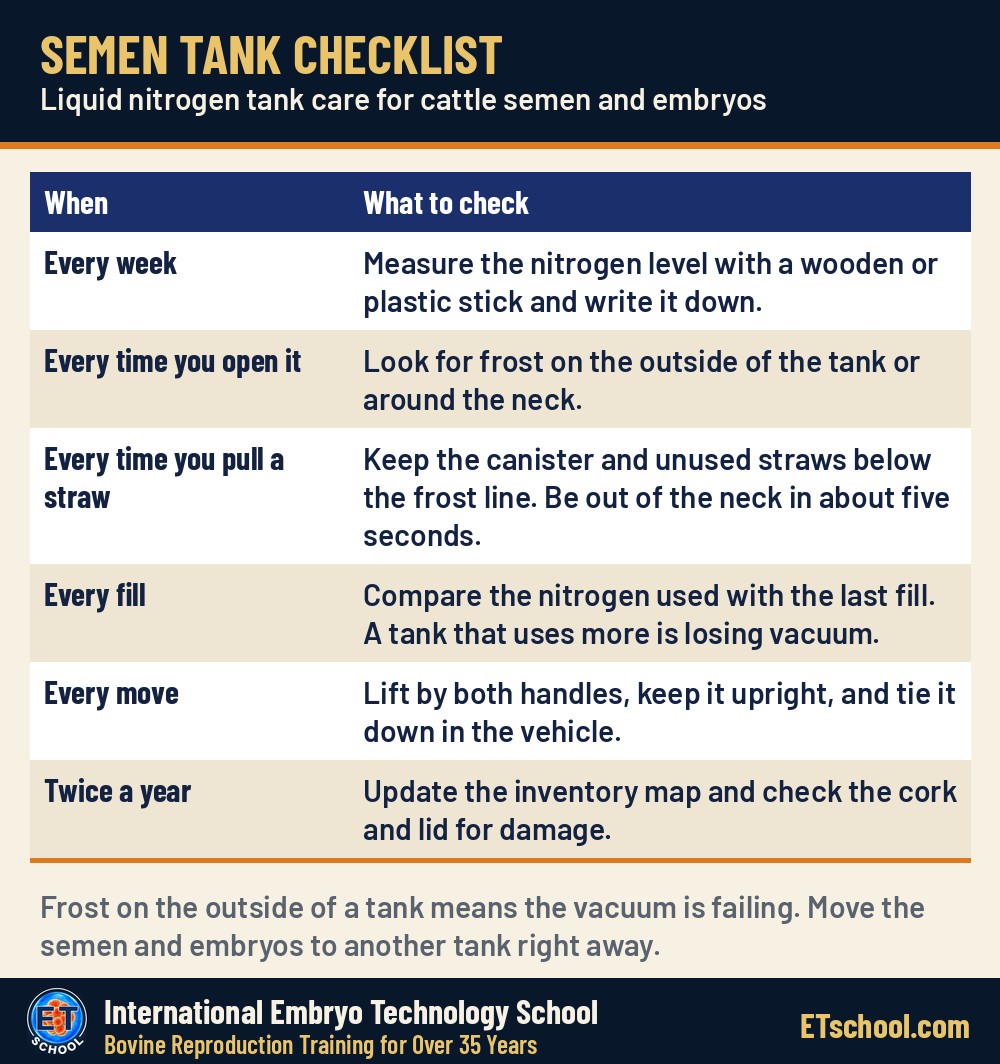 Semen tank checklist
How do you know a semen tank is failing?
The signs of a lost vacuum are on the outside of the tank:
- Frost or heavy sweating on the outside of the tank. A sound tank is at room temperature on the outside.
- Frost building up fast around the neck.
- Nitrogen use that has gone up since the last fill.
Have a plan before this happens. Know which neighbor, veterinarian or semen supplier has a tank you can use, and keep their phone number where you keep the tank.
Where should you keep a semen tank?
- Indoors, in a clean, dry place with good ventilation and good light. You need to see down the neck to work below the frost line.
- Off a damp floor. Set the tank on a wooden pallet or a rubber mat so the bottom is not sitting on bare concrete. We use rubber kneeling pads under ours, as in the photos above.
- Away from fertilizer, chemicals and anything corrosive.
- Away from direct sun and heat.
- Locked up or out of sight. The contents are worth more than the tank.
Nitrogen gas pushes oxygen out of a closed space. Keep the tank in a ventilated room, and do not carry it inside the closed cab of a vehicle.
How do you move a tank without damaging it?
The weak point of a tank is the neck, where the inner and outer shells join. A hard knock or a drop can crack that joint and release the vacuum.
- Lift the tank by both handles and keep it level.
- Do not drag it or roll it on its bottom edge.
- In a truck, stand it upright and tie it down so it cannot tip or slide.
- Put the cork back every time. A tank left open does not go dry at once, but it loses nitrogen faster. Replace a damaged cork.
How do you handle straws without damaging them?
Most damage to semen happens in the neck of the tank, a few seconds at a time. There is a frost line a few inches below the top of the neck. Below it the temperature is safe. Above it the temperature rises quickly.
- Raise the canister only as high as you need to see the cane you want. Keep it below the frost line.
- Take the straw with tweezers and lower the canister straight away. You have about five seconds.
- If you cannot find the straw in that time, lower the canister, let it cool, and start again.
- Never lift a cane out of the tank to read the label.
A straw that has thawed cannot be refrozen. Each time the unused straws on a cane are lifted into warm air they are damaged a little, and that damage adds up across a breeding season.
What should a tank inventory map show?
An inventory map is a sheet kept beside the tank, not in it. For every canister it lists each cane, the bull or the donor and sire, the number of straws, and the date they went in. With a map you know which canister and which cane before you open the lid, so the search takes seconds. Update it every time you use a straw, and check it against the tank twice a year.
Record embryos with extra care. Note the donor, the sire, the freeze date, the embryo stage and grade, and the freezing method, because the method decides how the embryo is thawed.
Safety with liquid nitrogen
Liquid nitrogen freezes skin on contact, much like a severe burn. Wear gloves and eye protection when you fill or measure a tank. If nitrogen touches your skin, flush the area with cool or lukewarm water. See a doctor for blisters or a deep burn.
Where you learn to do this
Tank care and semen handling are part of our cattle artificial insemination training. Students practice measuring a tank, working below the frost line and thawing straws before they breed live cattle. No prior experience is required for the AI course.
Thawing embryos is taught in our Thawing & Transferring Frozen Bovine Embryos course and in the Comprehensive bovine embryo transfer course, which also covers embryo freezing. Both require students to be competent at AI first. If you want to learn AI and embryo transfer together, our cattle AI and embryo transfer course teaches both in one 6.5-day trip, with no prior experience required.
The International Embryo Technology School has taught embryo transfer for over 35 years at our training facility in Senatobia, Mississippi.
References


|