
H5N1 and Dairy Reproduction: What the Outbreak Costs You in the Breeding Pen
When H5N1 turned up in dairy cattle in March 2024, almost everything written about it was about milk. That made sense at the time - the clinical picture was thick, discolored milk and a production collapse, and the immediate questions were about the milk supply.
Two and a half years on, the outbreak has been confirmed in more than 1,100 herds across 19 states, and a much clearer picture has emerged of what it does to a herd. The part that gets the least attention is also the part that lasts longest: what it does to your reproductive program.
Where the outbreak stands
The virus is clade 2.3.4.4b, genotype B3.13, and it was first confirmed in a Texas dairy cow in late March 2024. Since then it has moved between herds primarily through ordinary business traffic - people, vehicles and equipment moving from one operation to another - rather than through wild birds landing on your place. USDA's analysis of both the genomics and the epidemiology supports that, and it is worth internalizing, because it means the exposure you can actually control is the one that matters most.
The picture in 2026 is uneven rather than over. California released its last dairies from quarantine in February 2026 while remaining an affected state under continued surveillance. Texas confirmed its first dairy case of the year in June 2026. Idaho has been among the more active states this year, with the state veterinarian there describing spread driven primarily by shared equipment and shared personnel working across multiple farms rather than by wild birds.
Two federal orders remain the backbone of the response: the April 2024 order requiring a negative influenza A test before lactating dairy cattle move interstate, and the December 2024 National Milk Testing Strategy, which put bulk tank surveillance in place so a herd can be caught before anyone notices sick cows.
What it does to a herd
The best single description of an outbreak comes from a study of an affected Ohio herd. Clinical disease showed up in about 20 percent of the adult cows - 777 out of 3,876 - and ran roughly three weeks. Milk losses ran around 900 kilograms per affected cow. The researchers put the cost of a clinical case at approximately $950, and the total loss to that one farm at about $737,500 over the 67-day period they monitored.
Separately, a cow-level analysis found that cows with clinical HPAI faced a 1.74-fold greater hazard of death and a 2.61-fold greater hazard of being sold compared with cows that were not clinically affected.
Those are large numbers, and they are the ones that get quoted. The authors of the Ohio study noted something else that matters here: their figure was likely conservative, because it did not attempt to price in the ongoing reproductive adjustments the herd had to make.
That is the part worth digging into.
The reproductive damage
Several strands of research now point the same direction.
Reports from affected dairies describe abortions in mid to late gestation in infected animals. Investigators have detected viral RNA and influenza antigen in the lung and brain tissue of aborted fetuses, which raises the possibility of vertical transmission to the pregnant cow's calf.
Researchers have also found viral RNA in reproductive tissue - the uterus and the ovary - which is why the reproductive tract is now being discussed as a possible target of infection rather than simply collateral damage from a very sick animal.
And during periods of severe clinical disease, fewer cows returned to regular estrous cycles. That single sentence is the one with the longest tail. A cow that does not cycle back on schedule is a cow that breeds late, freshens late, and stays out of position in your calendar for a year or more.
The researchers themselves are careful, and so should we be: a causal link between infection and long-term reproductive damage in recovered animals has not been fully established, and further work is needed. But the practical advice that follows from it is the same either way, which is that a herd coming out of an outbreak should have its reproductive program reviewed rather than assumed.
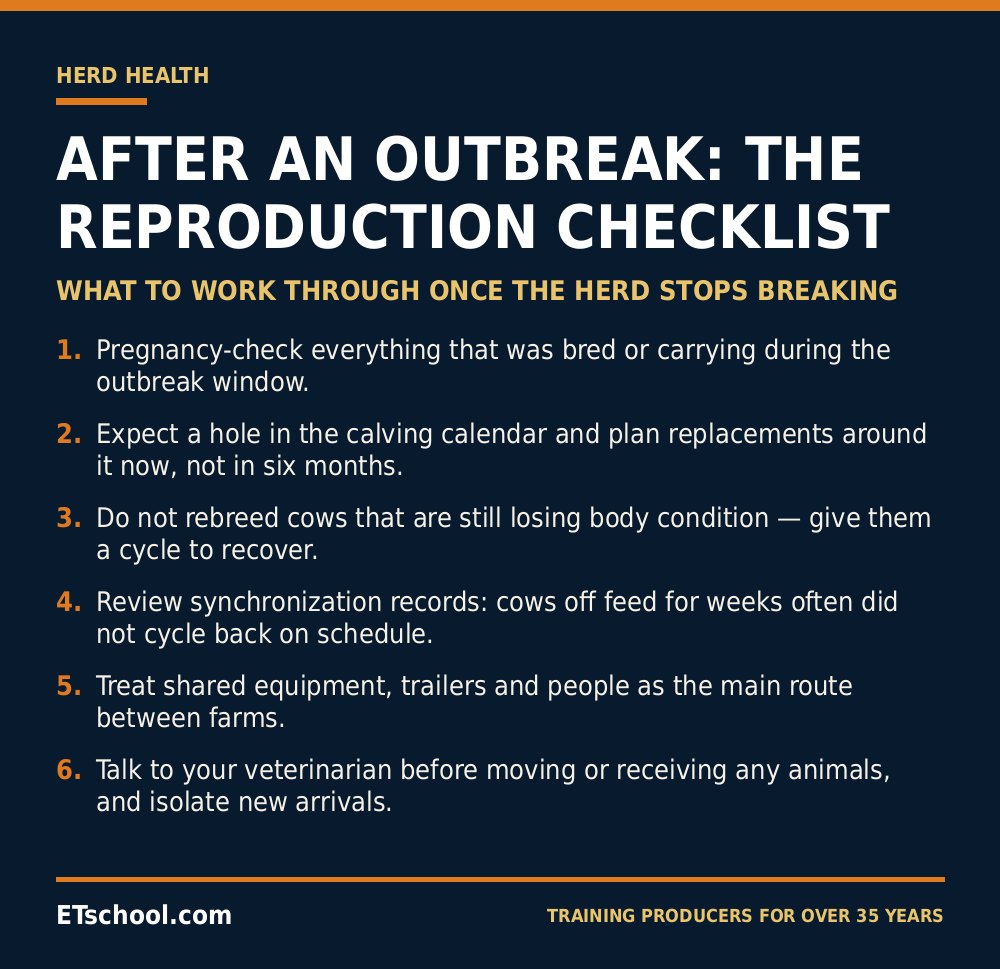 What to work through once the herd stops breaking.
Why this outlasts the milk loss
Milk production is a recoverable loss. It hurts, it shows up on one year's statements, and then it is behind you.
A hole in the breeding calendar is not like that. Cows that aborted, cows that failed to cycle back, and cows that were culled during the outbreak all come out of the same place - the group that was supposed to freshen next year. That gap moves forward through the herd. You feel it in replacement numbers, in the age structure of the herd, and in the cash flow of a milking string that is not evenly distributed across the calendar.
It is also expensive to fix by buying, because everyone else in the region is trying to buy at the same time.
Where reproductive management earns its keep
There are two practical points here for anyone rebuilding.
The first is biosecurity, and the specific form it takes. Because spread between farms runs on people, trailers and equipment rather than waterfowl, the control points are unglamorous and effective: dedicated equipment, cleaned vehicles, staff who do not move between operations, isolation and monitoring of arriving animals, and a conversation with your veterinarian before anything moves on or off the place.
The second is genetics. When a herd loses cows and pregnancies out of the same cohort, it does not just lose numbers - it loses the specific females it had spent years selecting. Embryo transfer is the fastest legitimate way to get a lot of calves out of a small number of high-value donors, which is exactly the position a herd is in after an outbreak takes out part of its best group. And moving genetics as frozen semen or embryos instead of moving live animals carries a very different biosecurity profile than trucking in replacements, which is worth weighing at a moment when animal movement is the thing everybody is trying to limit.
Learning the work
You don't need to be a veterinarian to take our courses. The International Embryo Technology School has been training producers, herdsmen, technicians and veterinarians in bovine reproduction for over 35 years, and our courses are open to anyone 18 or older.
- Bovine Artificial Insemination - no prerequisites, no prior experience required.
- Comprehensive Bovine Embryo Transfer - 4.5 days of hands-on training for students already competent at AI. Veterinarians and veterinary technicians can earn RACE-approved continuing education credit on this course.
- Combined AI and Embryo Transfer - both, in sequence, for students starting from scratch.
You will learn a skill you can use on your own herd and, in some states, offer as a service. The rules on that vary by state, so check yours.
For current case counts and state-by-state status, USDA APHIS maintains the authoritative list. If you have cattle showing reduced feed intake, a drop in production or abnormal milk, call your veterinarian and your state animal health official first.
References
- HPAI in Livestock and the Secure Our Herds program, USDA APHIS
- Avian influenza virus type A (H5N1) in U.S. dairy cattle, American Veterinary Medical Association
- The impact of highly pathogenic avian influenza H5N1 virus infection on dairy cows, Nature Communications
- Cow-level factors associated with risk of clinical HPAI H5N1 infection, Journal of Dairy Science
- Investigation of Avian Influenza A (H5N1) Virus in Dairy Cattle, U.S. Food and Drug Administration
- H5N1 Bird Flu Virus in Livestock, California Department of Food and Agriculture

|