
Fall or Spring Calving: Which Season Actually Pays in the Southeast?
Late August is when the question comes up. Fall calvers are checking heifers and getting the calving pasture ready. Spring calvers are weaning, hauling to town, and looking at a set of cows that just spent three months trying to breed back in ninety-degree heat.
And somebody always asks the same thing: am I calving at the right time of year?
It is a fair question, and the honest answer is that neither season is universally right. What is true is that the Southeast has a real advantage most of the country does not, and a lot of herds in this part of the world are running a spring calendar mostly because that is how it has always been done. Here is what actually separates the two.
The case for spring calving
Spring calving is the default across most of the United States, and there are good reasons for it.
A cow's nutrient demand peaks about sixty days after she calves. Calve in February or March and that peak lands right on top of green grass, which is the cheapest feed you will ever buy. She spends the winter dry, in the lowest-cost phase of her production year, and you are not hauling hay to a lactating cow in January.
Spring-born calves also tend to do better after weaning. Mississippi State Extension notes that although spring-born heifers often come off the cow lighter than fall-born ones, they post better post-weaning gains and better body condition scores at breeding time. That matters a great deal if you are retaining replacements or backgrounding rather than selling at the barn.
The costs are just as real. February and March are the wettest, coldest, muddiest weeks of the year in most of the Southeast, and small calves handle mud and cold far worse than mature cows do. Scours and respiratory problems in a wet calving pasture will erase the feed savings in a hurry. Spring-born calves also hit the ground into a summer of declining forage quality, and they sell in the fall run when everybody else is selling.
The case for fall calving
Fall calving means calves hitting dry, warm ground in September through November instead of a mud hole. That alone is worth something in a wet spring country.
The bigger advantage is what happens sixty to ninety days later, when you go to breed those cows back. A fall-calving herd breeds in late November through January. A spring-calving herd breeds in May through July. Heat stress is one of the most reliable killers of conception rates in cattle, and a cow being bred in December simply is not fighting the same battle a cow being bred in July is.
Weaning weights tend to favor fall calves in this region as well. And on price, fall-born calves wean in the spring, when supplies are lighter and demand from stocker and grass operators is stronger. Illinois Extension has put the seasonal advantage on those cattle at roughly four percent above the annual average price - not a fortune on one calf, but real money across a herd, every year.
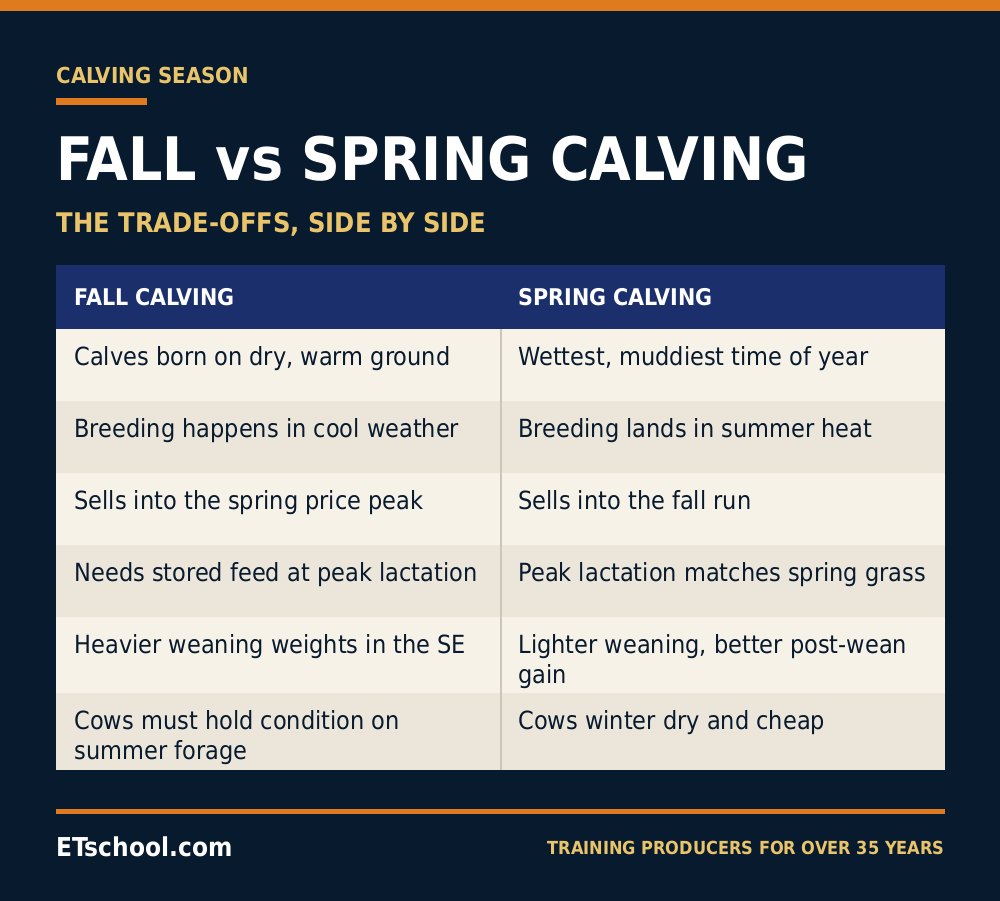 The trade-offs between fall and spring calving, side by side.
The catch is feed. A fall-calving cow hits peak lactation in December and January, when there is nothing growing. You will be feeding stored forage and supplement to a cow doing her hardest work, and in the fescue country of the mid-South you are also asking her to hold condition through the summer on forage that is losing quality. Alabama Extension makes the point plainly: fall systems lean harder on conserved forage and supplemental feed than spring systems do.
What the research actually found
Researchers at the University of Tennessee Institute of Agriculture ran simulation models on nearly two decades of data and concluded that for Southeastern beef producers, a fall calving season - roughly mid-September through mid-November - was the most profitable option. Just as interesting, it also showed the smallest swing in profit from year to year, which is to say it was the less risky of the two systems in this region.
That result is regional, and it is worth saying why. The Southeast's long forage growing season lets producers here calve ahead of hard winter weather in a way northern operations cannot. It is a genuine competitive advantage, and a good many herds in Mississippi, Alabama and Tennessee are not using it.
None of which means you should go home and change your calving season this week.
The number that beats both
Here is the part that gets lost in the fall-versus-spring argument: for most herds, the length of the calving window matters more than the month it starts.
A herd with a ninety-day calving season and a herd with a five-month calving season can both be "spring calvers." They are not running the same business. In the long calving season, the late calves are sixty to ninety days younger on sale day, they weigh less, and the cows that produced them have less time to recover before the next breeding season - so they tend to breed late again the following year, or come up open. The problem feeds itself.
Where controlled breeding changes the math
This is where the reproductive tools stop being a luxury item and start being the practical answer to both problems at once.
Estrous synchronization and artificial insemination let you set the front end of your calving season deliberately instead of hoping the bull got the job done in the first cycle. You decide the date. A synchronized AI breeding puts a large block of your cows bred within a few days of each other, which pulls the whole calving distribution forward and tightens it - and an earlier-born calf is a heavier calf on the same sale day.
That control matters even more if you are considering a switch between seasons. Moving a cow herd six months on the calendar is not something you do in one jump, and it is expensive if you handle it badly. Synchronization gives you a way to move a portion of the herd deliberately, or to run a split herd with a defined breeding window on each half, rather than letting the change happen by attrition.
Embryo transfer works the other end of the problem. Once you have decided when you want calves on the ground, ET is how you decide what those calves are - putting the genetics of your best female into as many recipients as you can carry, instead of getting one calf a year out of her.
Doing this work yourself changes the economics again, because the technician's schedule stops setting your breeding window. When you can breed on your own timeline, a tight calving season becomes something you control rather than something you hope for.
Learning it yourself
You don't need to be a veterinarian to take our courses. The International Embryo Technology School has been training people in bovine reproduction for over 35 years, and our courses are open to anyone 18 or older.
- The Bovine Artificial Insemination course has no prerequisites and requires no prior experience - it is the right starting point for a producer who wants to breed his own cows.
- The Comprehensive Bovine Embryo Transfer course is 4.5 days of hands-on work for students who are already competent at AI. Veterinarians and veterinary technicians can earn RACE-approved continuing education credit on this course.
- The Combined AI and Embryo Transfer course covers both, in order, for students starting from scratch.
You will learn a skill you can use on your own herd and, in some states, offer as a service - though the rules on that vary by state, so check yours before you plan a business around it.
Whichever season you calve in, the herds that do well are the ones that decided on purpose.
References
- Fall Versus Spring Calving: Considerations and Profitability Comparison, University of Tennessee Institute of Agriculture
- Calving Season Selection Considerations, Mississippi State University Extension
- Determining the Best Time of Year to Calve, Alabama Cooperative Extension System
- Comparing Spring vs. Fall Calving, University of Illinois Extension
- Calving Season Considerations, University of Missouri Extension

|