
Body Condition Scoring Beef Cows: A Month-by-Month Plan for Every Calving Season
Everybody knows a cow should calve in decent flesh. The trouble is that "decent flesh" usually gets judged on the day she calves, and by then it is the most expensive time of the year to fix it.
Body condition scoring works best as a calendar, not a verdict. Here is when to score, what to aim for, and when each fix is cheapest - for spring and fall calving herds.
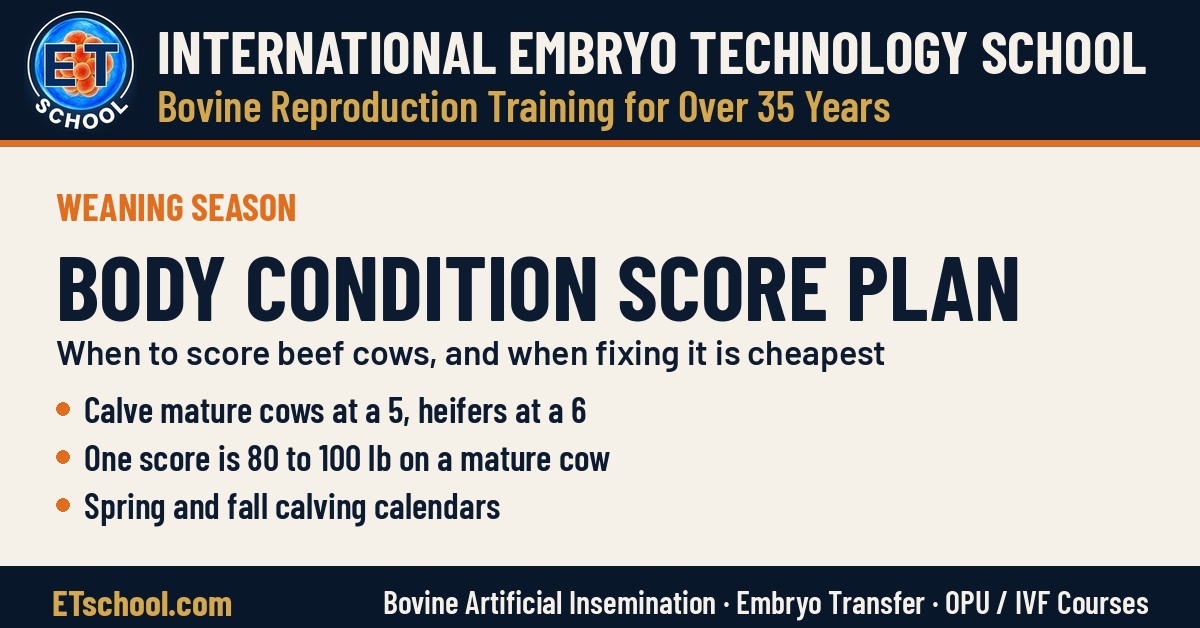
What body condition score should a cow be at calving?
On the 1-to-9 scale most extension services use, a mature cow should calve at a body condition score of 5, and a first-calf heifer at 6. Heifers are held a point higher because they are still growing while they nurse their first calf and try to rebreed. Oregon State recommends at least a 5 but no more than a 7 for mature cows, and 6 to 7 for first-calf heifers.
Why it matters: body condition at calving is the biggest single factor in how fast a cow cycles again. Ohio State estimates a cow calving at a 5 returns about $100 more than one calving at a 4, and every 21-day heat cycle she misses can cost up to 39 pounds of weaning weight.
How much weight is one condition score?
More than it looks. Mississippi State works the example: a 1,200-pound cow at a 5 has to gain about 96 pounds to reach a 6. A common rule of thumb is roughly 80 pounds per score for a mature cow, and closer to 150 pounds for a first-calf heifer. That is why a one-point shortfall three weeks before calving is almost impossible to make up.
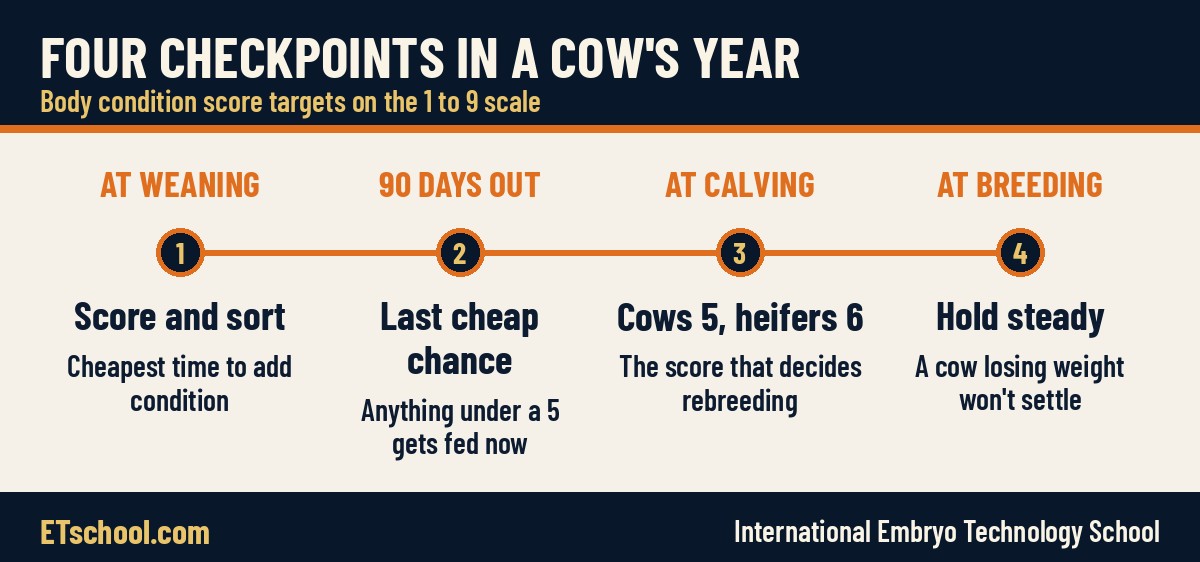 Score, adjust and hold: the four checkpoints in a cow's year.
The four times to score
1. At weaning. The most important score of the year. Her requirements drop the moment the calf comes off, so weaning to calving is the easiest and cheapest window to add condition. Sort the thin cows - and the young cows, which are usually the thinnest - into their own group now.
2. About 90 days before calving. Your last chance to add condition at a reasonable cost. Wisconsin Extension calls this the last point to put weight on economically. Anything under a 5 gets more feed now, not later.
3. At calving. This is the score that decides rebreeding. Write it down. It tells you whether the plan worked, and it flags the cows that will need extra help before the bull goes in or the breeding season starts.
4. At the start of breeding. Calving to breeding is the hardest stretch of the year to hold condition, because she is headed into peak milk. A cow that is losing weight at breeding is much less likely to conceive, even at an acceptable score.
The spring-calving calendar
For a herd calving in February and March:
- September to October: wean and score. Group the thin cows and the first-calf heifers.
- October to November: feed the thin group back up on stockpiled grass or supplement while requirements are low.
- Early December, about 90 days out: score again. Last cheap chance to add condition.
- February to March: score at calving and record it.
- April to May: score at the start of breeding, and protect condition through peak lactation.
The fall-calving calendar
For a herd calving in September and October:
- April to May: wean and score. Spring grass makes this the easiest recovery window of the year.
- Early June, about 90 days out: score again. Watch heat stress and fescue, which can pull cows down through the summer.
- September to October: score at calving.
- November to December: score at breeding as forage quality falls off, and plan hay and supplement now.
Don't overshoot
Fatter is not better. Ohio State's specialists put it plainly: routinely feeding cows above a 6 is not cost effective. The goal is to calve at the target and hold steady into breeding - not to put a show finish on a brood cow.
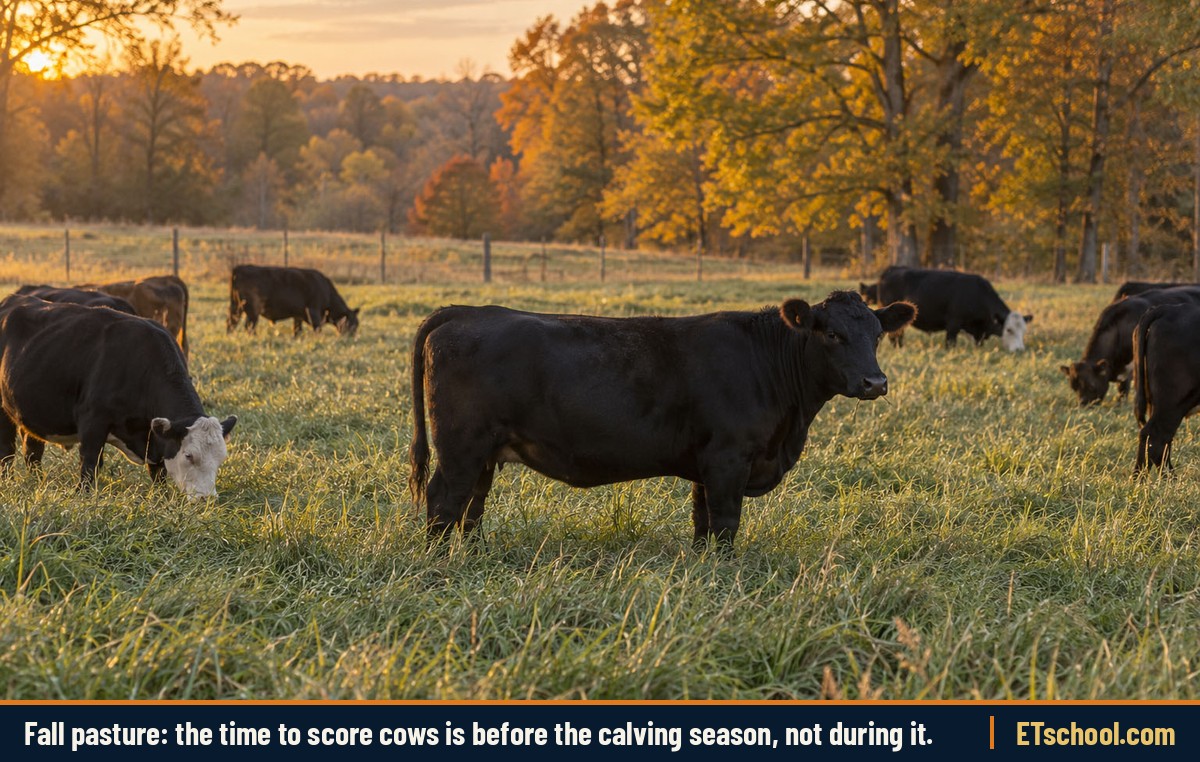 After weaning her needs drop, and condition is cheapest to put back.
Condition gets her cycling. Breeding gets her bred.
A cow in the right condition at calving is ready to breed back. What happens next - catching her heat, timing insemination and handling semen correctly - decides whether she settles early in the season. That is where training pays.
You don't need to be a veterinarian to take our courses. They are open to anyone 18 or older, and the International Embryo Technology School has been teaching embryo transfer for over 35 years.
- Our cattle artificial insemination training course has no prerequisites and requires no prior experience. It covers the estrous cycle, heat detection, synchronization and semen handling, hands-on with live cattle.
- The Combined AI and Embryo Transfer course adds embryo transfer to the AI training in one trip, also with no prior experience required. It is our most popular course.
Score at weaning, fix it early and calve at the target. The breeding season takes care of itself a lot more often when you do.
References
- Body Condition Scoring Beef Cattle, Mississippi State University Extension
- Body condition scoring: Monitoring beef cow energy reserves, Oregon State University Extension
- Body Condition Scoring, Beef Cow Nutrition and Reproduction, Ohio BEEF Cattle Letter
- Body Condition Scoring Beef Cows, University of Georgia Extension
- Body condition score as a nutritional management tool, Penn State Extension
- Rugging up your cows, University of Wisconsin Extension

|