Adding Cattle Embryo Transfer and OPU Services to Your Veterinary Practice
Every fall, the same call comes into a lot of large-animal practices: a client with a good cow asks whether you do embryo work. Too often the answer is "no, but I can give you a name" - and the flush fees, the transfer fees and the client relationship drive off down the road to someone else.
For a bovine or mixed practice, embryo transfer and ovum pick-up (OPU) are among the few services that grow with the cattle market instead of fighting it. Here is the business case, and what it takes to offer them.
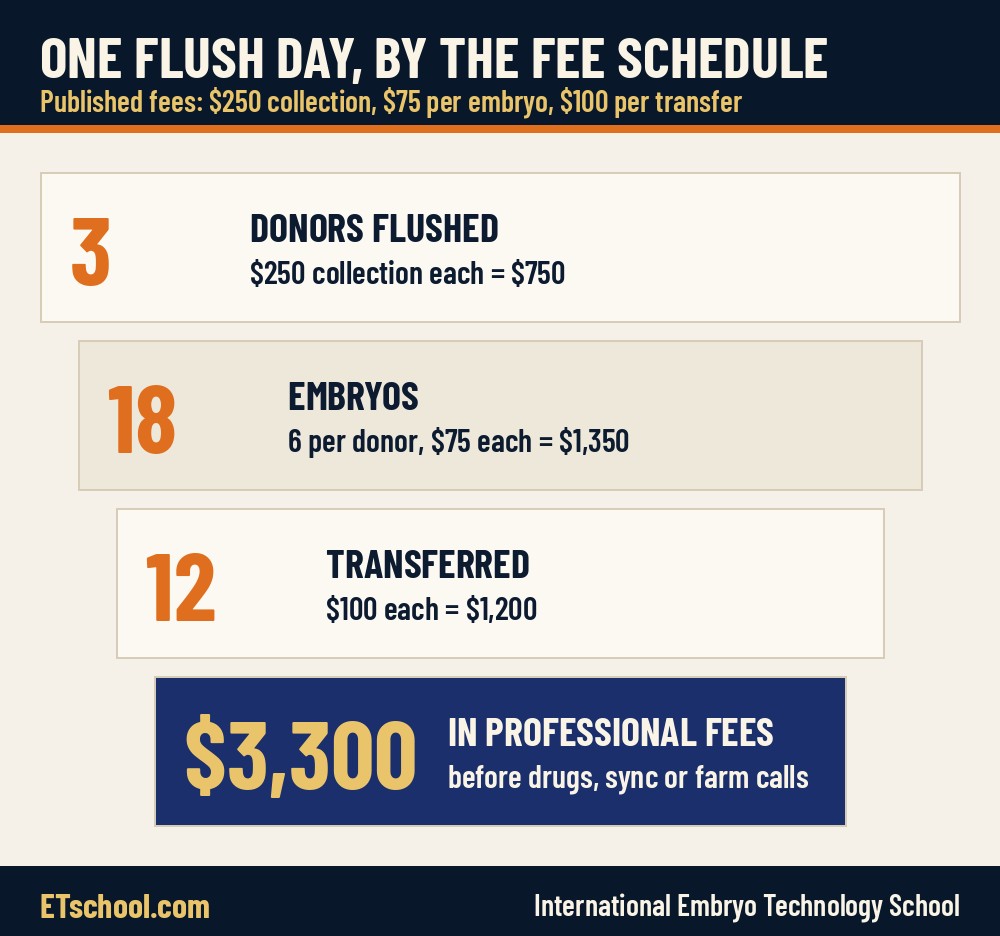 What one modest flush day brings in, using a published fee schedule.
Why are more clients asking for embryo work?
Two things are pushing demand. The first is the market. The country started 2026 with about 4.7 million beef replacement heifers - the second-lowest number since the 1940s - and producers who want to rebuild quality fast are looking at embryos rather than waiting generations on natural service.
The second is the technology. Worldwide, in vitro produced embryos now outnumber flushed embryos roughly five to one, and North America alone reported more than a million IVF cattle embryos in 2023. The International Embryo Technology Society's 2024 figures show conventional superovulation averaging about 5.7 transferable embryos per flush, while transfers of in vitro embryos rose another 10.6% in a single year. Your clients are reading about both, and they want someone local who can do the work.
What embryo services actually earn
Look at almost any published price list and the pieces are the same: a collection fee per donor, a fee per embryo to process, freeze or transfer fresh, and a fee per recipient transferred. One Texas embryo business lists a $250 collection fee, $75 per embryo and $100 per direct-thaw transfer. A Missouri practice charges $45 per embryo to freeze or transfer fresh. OPU aspirations commonly run $250 to $300 per donor, before the lab's IVF fee.
Run a modest flush day through the Texas list: three donors averaging six embryos each, with a dozen transferred and the rest frozen. That is $750 in collection fees, $1,350 in embryo fees and $1,200 in transfers - about $3,300 in professional fees from one day's work, before drugs, synchronization, housing or farm calls. Your own fee schedule will differ, but the shape holds: embryo work pays well per hour, and it repeats. A good donor can be flushed again in about 60 days, and an OPU donor can be aspirated every one to two weeks.
What it takes to add embryo transfer
The equipment list for conventional embryo transfer is shorter than most practitioners expect: flush catheters and media, an embryo filter and search dishes, a good stereomicroscope, freezing equipment and liquid nitrogen storage. Most bovine practices already own the ultrasound. The real investment is skill - superovulation protocols, embryo flushing technique, finding and grading embryos under the scope, freezing them properly and transferring them into well-synchronized recipients.
That is exactly what our cattle embryo transfer course teaches. The Comprehensive Bovine Embryo Transfer course is 4.5 days of hands-on training in flushing, embryo searching and grading, freezing and non-surgical transfer, for students who are already competent at artificial insemination. Veterinarians and veterinary technicians can earn RACE-approved continuing education credit on this course, but most come for the service they take home.
What it takes to add OPU and bovine IVF
OPU is a step up. It needs an ultrasound with a transvaginal aspiration setup, a steady hand and a working relationship with an IVF lab that will mature, fertilize and culture the oocytes you collect. In return it opens doors conventional flushing cannot: OPU works on pregnant donors, on young heifers and on cows that do not respond to superovulation, and bovine IVF stretches expensive or sexed semen across many more embryos.
Our OPU in cattle training course is the most advanced course we teach. It is built for people with experience in palpation, AI and embryo transfer - or who have completed our embryo transfer course first - and most of its students are veterinarians. A practice can also send a technician through our OPU Lab Technician Course alongside the veterinarian, so the person handling oocytes in the lab learns searching and processing at the same time.
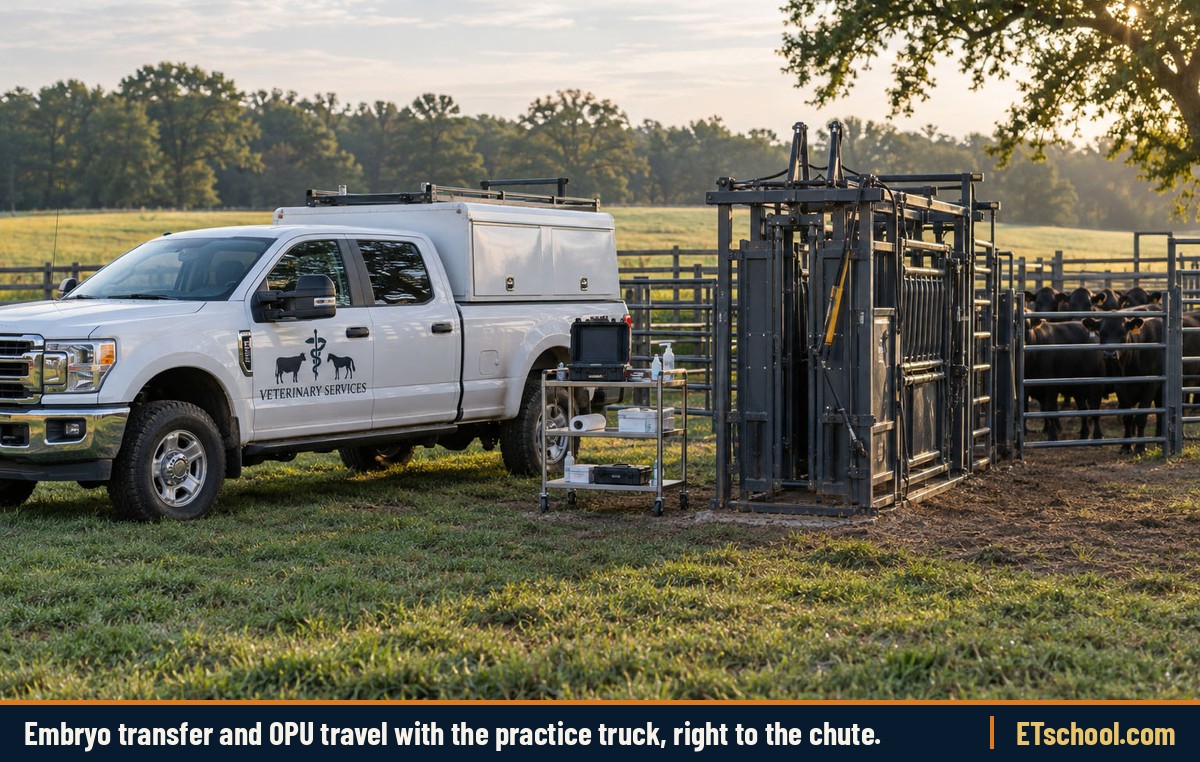 One embryo client is a year of work at the chute.
Where to start
A sensible order for most practices:
- Start with conventional embryo transfer. It uses equipment you mostly have, and it teaches the recipient management every embryo program depends on.
- Build a recipient routine for your clients: synchronization calendars, heat checks and pregnancy diagnosis.
- Add OPU once you have steady donors and a lab partner, so the aspirations have somewhere to go.
- Train a technician alongside you, so the service does not depend on one person.
On that last point: we regularly hear from people who want to work as embryo transfer technicians, and we pass their names along to practitioners. There are trained hands out there if you are building a team.
Training at the International Embryo Technology School
The International Embryo Technology School has been teaching embryo transfer for over 35 years at our training facility in Senatobia, Mississippi - hands-on, on live cattle, in small classes. You don't need to be a veterinarian to take our courses - they are open to anyone 18 or older - but veterinarians and veterinary technicians are a big part of every embryo transfer and OPU class.
- The Comprehensive Bovine Embryo Transfer course - 4.5 days, for students already competent at AI, with RACE-approved CE credit for veterinarians and veterinary technicians.
- The Bovine OPU (Ovum Pick-Up) course - for practitioners with palpation, AI and embryo transfer experience who want to add aspiration and IVF.
- For staff starting from the beginning, the Combined AI and Embryo Transfer course covers both, in order, with no prior experience required.
Your clients are already asking. The practices that can say yes keep the work.
References
- 2024 Statistics of Embryo Production and Transfer in Domestic Farm Animals, IETS
- Development of the world farm animal embryo industry over the past 30 years, Theriogenology
- Reproductive strategies for dairy herd improvement: MOET or OPU-IVF?, Progressive Dairy
- Cow Pricing, Champion Genetics
- Conventional Embryo Transfer, Bishop Reproductive Services
- Bovine Division Pricing, ReproLogix
- Buy, Raise or Wait? What the Replacement Heifer Math Looks Like in 2026, Drovers

|